
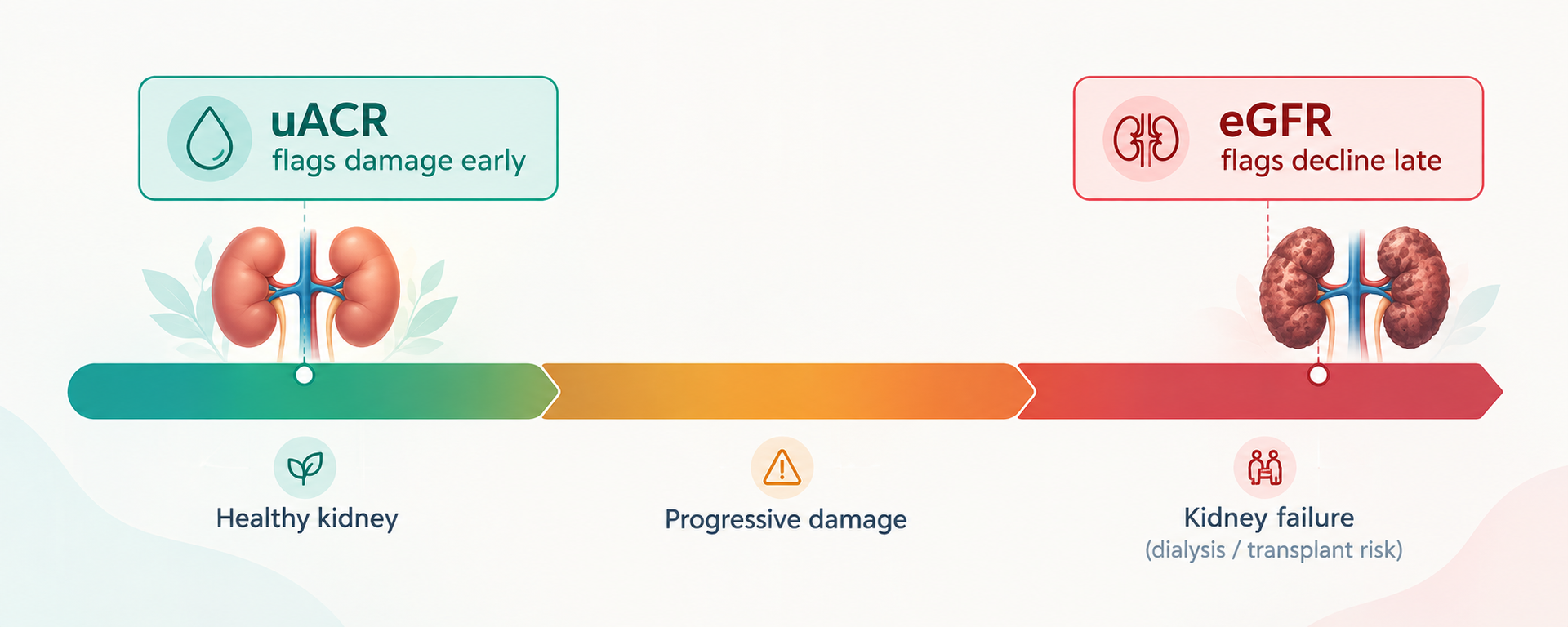
Why uACR, Not eGFR Alone, Is the Real Frontline of CKD Detection
Chronic kidney disease rarely announces itself. There is no sharp pain to send a patient to a doctor, no early symptom that maps cleanly onto a failing nephron. By the time fatigue, swelling, or breathlessness appear, the kidneys have often already lost the majority of their functional reserve.
This is the central problem of CKD: it is a disease that is easy to miss and expensive in every sense to catch late. The tools used to screen for it matter enormously, and for decades, the tool that has dominated clinical practice has not been the one best suited to catching the disease early. That tool is the estimated glomerular filtration rate, or eGFR.
The biomarker that should sit at the front of every screening protocol is the urine albumin-to-creatinine ratio, or uACR, and understanding why requires a brief walk through the history of how we have tried, and often failed, to catch kidney disease in time.
A Brief History of Looking for Kidney Damage in the Wrong Place
The earliest clinical approaches to kidney disease were built around what could be seen and measured with the technology available at the time: serum creatinine and the urine dipstick. Serum creatinine, a waste product of muscle metabolism cleared by the kidneys, became the default marker of kidney function through most of the twentieth century. Elevated creatinine, so the logic went, meant impaired filtration. Laboratories built formulas around it the Cockcroft-Gault equation in the 1970s, and later the Modification of Diet in Renal Disease (MDRD) and CKD-EPI equations to convert a single serum value into an estimated filtration rate, adjusting for age, sex, and body size. This became eGFR, and it remains, even today, one of the two pillars of the KDIGO (Kidney Disease: Improving Global Outcomes) framework for staging CKD.
The urine dipstick, meanwhile, offered a cheap, fast way to check for protein in urine but only at the coarse end of the spectrum. A standard dipstick typically turns positive only once protein losses climb into the hundreds of milligrams per day, well past the point where kidney damage is early or subtle. For a long stretch of nephrology's history, then, screening essentially meant: check creatinine, estimate filtration, and dipstick the urine if there was reason for suspicion. Both approaches share the same structural weakness: they are built to detect loss of function, not the onset of damage. And loss of function is, almost by definition, a late-stage signal.
This is not a small technical nuance. It is the reason CKD has earned its reputation as a "silent" disease. Estimates from health systems in different countries consistently suggest that a large majority of people living with CKD, frequently cited at somewhere close to 90%, are unaware they have it until the disease has progressed well past its earliest, most treatable stages. Patients often present to nephrology only after eGFR has already fallen substantially, at which point the conversation shifts from prevention to damage control: aggressive blood pressure and glycemic management, dietary restriction, and, for a meaningful proportion of patients, eventual dialysis or transplantation.
The tragedy is not that these interventions are unavailable it is that they are being deployed at the point in the disease's trajectory where they can do the least good.
Why eGFR, Used Alone, Misses the Early Disease
The kidney has extraordinary functional reserve. A person can lose a substantial fraction of their nephron mass and still register a statistically "normal" eGFR, because the remaining, healthy nephrons compensate by filtering harder, a phenomenon nephrologists call hyperfiltration. This compensatory mechanism is a double-edged sword: it protects short-term function, but it also means eGFR can sit comfortably within the "normal" range (Stage G1 or G2 in the KDIGO classification, generally 90 mL/min/1.73m² and above, or 60–89) for years while underlying structural injury is actively accumulating. eGFR is, in other words, a measure of the kidney's output, and outputs are the last thing to change when a system is failing gracefully rather than catastrophically.
This creates a genuine screening blind spot. A person with early diabetic or hypertensive kidney injury the two most common drivers of CKD worldwide can have microvascular damage occurring inside the glomeruli well before their filtration capacity shows any measurable decline. Relying on eGFR alone as a screening test means, structurally, waiting for the disease to become advanced enough to show up as a drop in function. Clinical audits comparing screening strategies have repeatedly found that a substantial share of patients with clinically meaningful kidney injury would be missed entirely if eGFR were the only test used; some analyses put the proportion of elevated-albuminuria patients who would be missed by eGFR-only screening at roughly 60%. That is not a rounding error. That is a majority of a warning system failing to fire.
Where uACR Changes the Picture
This is exactly the gap that uACR is built to close. The test measures the ratio of albumin, a protein that a healthy glomerular filtration barrier should almost entirely retain, to creatinine in a urine sample, expressed in milligrams of albumin per gram of creatinine. Under the KDIGO framework, a uACR below 30 mg/g is considered normal to mildly increased (category A1); 30–300 mg/g represents moderately increased albuminuria, historically termed microalbuminuria (A2); and above 300 mg/g is severely increased (A3). What makes this test valuable for early detection is what it is actually measuring: not the kidney's downstream filtering capacity, but the structural integrity of the glomerular filtration barrier itself.
Albumin is a relatively large molecule. In a healthy glomerulus, the filtration barrier's size- and charge-selective architecture keeps it almost entirely out of the urine. When that barrier is damaged by the microvascular stress of chronic hyperglycemia, by sustained hypertensive pressure, or by early inflammatory or immune-mediated injury, albumin begins leaking through in small amounts long before enough nephrons are lost to move the needle on eGFR. Microalbuminuria is, in this sense, one of the earliest detectable footprints of kidney injury: a molecular signal of a gate starting to fail, not evidence that the whole system has already gone down. This is precisely why nephrology guidelines increasingly describe albuminuria appearing before eGFR decline in the natural history of the disease, particularly in diabetic and hypertensive kidney disease the two conditions responsible for the overwhelming share of the global CKD burden.
There is also a second dimension to uACR's clinical value that goes beyond kidney staging: cardiovascular risk. Albuminuria is now understood not just as a kidney-specific signal but as a marker of generalized endothelial and vascular dysfunction. An elevated uACR even in a patient whose eGFR is entirely normal is associated with meaningfully higher cardiovascular risk. This means uACR is doing double duty as a screening tool: it is simultaneously an early warning for kidney damage and an independent flag for cardiovascular vulnerability, which matters enormously in a disease landscape where cardiovascular events, not kidney failure itself, are the leading cause of death in people with early-stage CKD.
A Direct Comparison: Reliability for Early Screening
Framed side by side, the case for uACR as the forefront screening tool becomes clear:
What each test actually detects. eGFR is a functional measure; it tells you how well the kidneys are currently filtering blood, calculated indirectly from serum creatinine. uACR is a structural/damage measure; it tells you whether the filtration barrier is intact. Damage precedes dysfunction. A test built around damage will, almost by definition, fire earlier than a test built around dysfunction.
Sensitivity in early-stage disease. Because of the kidney's hyperfiltration reserve, eGFR can remain in the normal range for years despite active glomerular injury, generating false reassurance. uACR is sensitive to injury at the microalbuminuria stage, when albumin losses are still in the tens-to-low-hundreds of milligrams range well before a dipstick would register anything and well before eGFR shows measurable decline. In diagnostic accuracy studies of point-of-care uACR testing against laboratory reference standards, sensitivity for detecting clinically significant albuminuria has been reported in the range of roughly 85–96%, which is a strong performance for a screening test intended to flag patients for further nephrology work-up rather than serve as a definitive diagnosis on its own.
What gets missed without it. The clinical audit literature on this point is fairly consistent: patients screened with eGFR alone show a meaningfully lower detection rate of kidney injury than those screened with uACR, particularly in diabetic populations, where the classic pattern of diabetic nephropathy often begins as isolated albuminuria with preserved eGFR. Community hospital datasets have found that the proportion of patients with abnormal uACR but normal eGFR meaningfully exceeds the proportion with abnormal eGFR but normal uACR, a pattern that, on its own, settles the question of which test catches disease earlier.
Complementary, not competing, roles. None of this makes eGFR obsolete. eGFR remains essential for staging disease severity once it is identified, for dosing renally cleared medications, and for determining when a patient needs referral for advanced interventions. The KDIGO "heat map," which cross-tabulates eGFR category against albuminuria category, exists precisely because the two tests answer different questions and are most powerful used together. But when the specific goal is early screening in an at-risk population of patients with diabetes, hypertension, obesity, or a family history of kidney disease, uACR is the test that should be run first and run regularly, with eGFR completing the clinical picture rather than serving as the sole gatekeeper.
Practicality as a screening tool. uACR also has a practical advantage that matters for real-world screening programs: it can be measured from a single spot urine sample, does not require fasting or venipuncture, and modern point-of-care analyzers can return a quantitative result within minutes at the bedside or in a primary care clinic. This lowers the barrier to annual screening precisely where it matters most in high-volume primary care and community health settings, where the at-risk population is largest, and follow-up visits cannot always be guaranteed.
The Cost of Catching CKD Late
The consequence of screening strategies that lean too heavily on eGFR is not abstract. It shows up in the demographics of nephrology clinics, where a large share of newly referred patients arrive already in Stage 3b, 4, or 5 disease stages where the conversation has shifted from slowing progression to preparing for renal replacement therapy. It shows up in the economic burden CKD places on health systems, where the cost of managing dialysis and transplantation dwarfs the cost of early intervention many times over. And it shows up in the clinical reality that many of the interventions proven to slow CKD progression tight blood pressure control, SGLT2 inhibitors, RAAS blockade, glycemic optimization are dramatically more effective the earlier they are started.
A patient identified with microalbuminuria and a normal eGFR has years of intervention runway ahead of them. A patient identified only once eGFR has fallen below 30 mL/min/1.73m² has a much narrower window, and in many cases, is already on a trajectory toward dialysis or transplant regardless of how aggressively treatment begins.
This is the clinical argument, stripped of anything but the physiology and the data: CKD is a disease that begins silently, with structural damage that precedes functional decline by years. A screening strategy anchored to eGFR alone is structurally biased toward late detection, because it is measuring the wrong stage of the disease process. uACR, by contrast, is built to catch exactly the signal that eGFR is blind to: the earliest molecular evidence that the glomerular filtration barrier has begun to fail.
For every patient with diabetes, hypertension, or another recognized CKD risk factor, an annual uACR test is not a supplementary nicety. It is the test most likely to catch the disease while it is still, in the fullest sense of the word, manageable, and it deserves to sit at the front of the screening protocol, not as an afterthought once eGFR has already raised the alarm.