
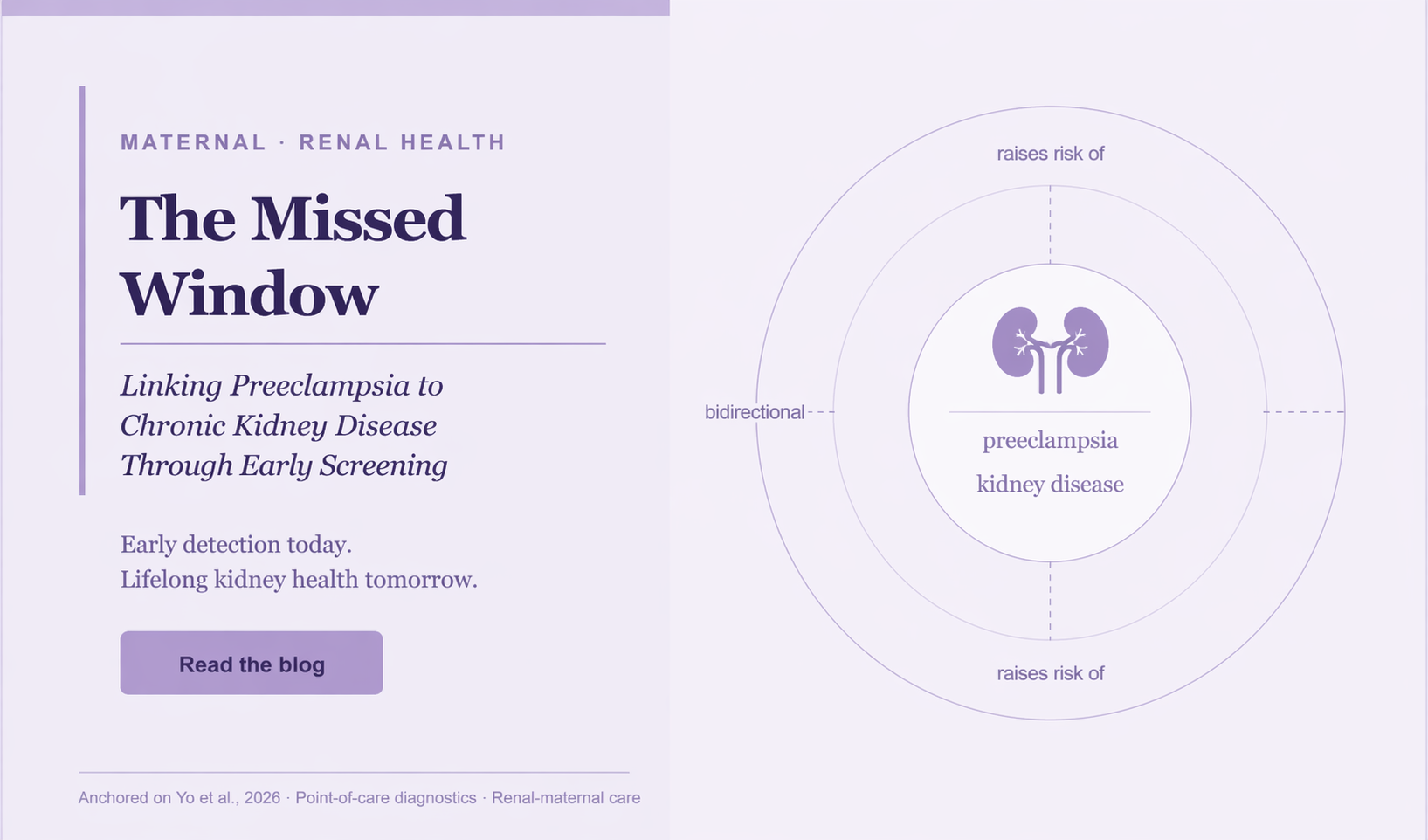
The Missed Window: Linking Preeclampsia to Chronic Kidney Disease Through Early Screening
Chronic kidney disease (CKD) is one of the most silently advancing conditions in modern medicine. It affects over 10% of the global population, yet a significant proportion of those living with it remain undiagnosed — often until kidney function has declined substantially. In parallel, maternal health complications such as preeclampsia are typically viewed as acute, pregnancy-bound events. Once delivery occurs and blood pressure normalises, many assume the chapter is closed.
It isn’t. Increasingly, evidence suggests that pregnancy is not merely a transient physiological state — it is a stress test for long-term kidney health. And preeclampsia may be one of the most informative results of that test we’ve been failing to read.
UNDERSTANDING THE MARKER
Preeclampsia: a complication, or a signal?
Clinically, preeclampsia is defined by the onset of hypertension after 20 weeks of gestation, accompanied by proteinuria or evidence of end-organ dysfunction. It affects 2–8% of pregnancies globally and remains a leading cause of maternal and neonatal mortality. But its significance has long been understood in isolation — a problem of pregnancy, managed during pregnancy, and largely forgotten after pregnancy.
That framing misses a crucial biological reality. Preeclampsia is not merely a response to pregnancy — it reflects significant endothelial stress and renal strain. The kidneys filter roughly 150 litres of blood daily; under the hemodynamic burden of preeclampsia, this system is pushed to its limits. For many women, the condition does not create kidney damage from scratch — it reveals damage that was already subclinical, already progressing beneath the surface.
“This raises a critical question — does preeclampsia cause kidney disease, or does it reveal it? Increasingly, the answer appears to be: both.”
THE EVIDENCE BASE
What the research tells us
A growing body of literature, anchored most recently by Yo et al. (2026), confirms what clinicians have long suspected: women with a history of preeclampsia show a significantly higher prevalence of laboratory markers consistent with CKD — even years after delivery. Specifically, studies document persistent reductions in estimated glomerular filtration rate (eGFR) and the continued presence of albuminuria and proteinuria, markers of lasting renal impairment.

What makes this particularly significant is not just the association — it is the persistence. These are not transient abnormalities that resolve post-partum. They are measurable, lasting changes to kidney function that, without monitoring, will progress undetected. And yet, postpartum women are rarely followed for kidney function. In most healthcare settings, obstetric care ends within six weeks of delivery. After that, renal assessment falls into a gap — neither obstetrics nor primary care routinely fills it.
BIDIRECTIONAL RISK
When CKD comes first
The relationship between preeclampsia and CKD is not a one-way street. Pre-existing CKD — even at mild stages — significantly elevates the risk of developing preeclampsia during pregnancy. Women with known renal impairment face higher rates of adverse maternal outcomes, preterm delivery, and disease progression. The kidney, already under strain, is further challenged by the hemodynamic demands of gestation.
The relationship is not linear — it is bidirectional and reinforcing, creating a cycle of risk. Women with CKD are more likely to develop preeclampsia. Women with preeclampsia are more likely to develop CKD. Without early identification and intervention, this cycle runs unchecked.
THE SYSTEMIC GAP
The real problem: we detect disease too late
If laboratory markers can identify CKD risk after preeclampsia — reduced eGFR, elevated albumin, proteinuria — why are they so rarely used before the disease becomes symptomatic?
The answer lies in how healthcare systems are structured. Antenatal care, while increasingly comprehensive, still lacks standardised baseline renal profiling. eGFR calculations are not routinely computed from early-pregnancy blood results. Quantitative proteinuria testing — which distinguishes transient from persistent proteinuria — is inconsistently applied. The system is designed to detect problems when they surface clinically, not when biomarkers first signal risk.
DIAGNOSTIC BLIND SPOTS IN MATERNAL CARE
No baseline renal function testing in early pregnancy · Minimal use of eGFR or quantitative proteinuria · No formal postpartum renal surveillance for high-risk women · CKD missed until symptoms escalate
The result is a system that waits for a woman’s kidney function to visibly deteriorate before intervening — at a point when intervention becomes reactive rather than preventive.
A STRATEGIC REFRAME
From detection to prediction
What should change is not merely the existence of follow-up care, but the architecture of when and where renal assessment occurs. The model needs three shifts:
Early pregnancy: Baseline renal function testing as a standard component of antenatal care — establishing a reference point against which changes can be measured. A woman who presents with subclinically reduced eGFR at 10 weeks needs a fundamentally different care pathway from one with normal function.
During pregnancy: Serial monitoring for women identified as high-risk — those with prior preeclampsia, pre-existing hypertension, or early proteinuria. Longitudinal data, not single snapshots, reveal the trajectory.
Postpartum: Continued renal surveillance beyond the six-week mark for women who experienced preeclampsia. If studies like Yo et al. document persistent renal markers years after delivery, the monitoring window must extend accordingly.
BRIDGING THE GAP
Why point-of-care diagnostics are not optional
The logical response to this evidence is expanded testing — but in practice, lab-based follow-ups remain inaccessible in many settings. Referral pathways are slow. Specialist appointments are delayed. In rural and low-resource environments, centralised laboratory infrastructure is simply unavailable to the women most at risk.
This is where point-of-care (PoC) diagnostics shift from useful to essential. The ability to detect proteinuria, assess renal markers, and integrate eGFR estimates at the site of care — in an antenatal clinic, a rural health post, a community pharmacy — removes the logistical barriers that currently delay identification of high-risk women.
“The gap is not in knowledge — it is in the deployment of diagnostics where care actually happens.”
Solutions like multi-test renal panels at the point of care, incorporating eGFR integration alongside proteinuria and albumin detection, directly operationalize what the evidence demands: early screening, risk stratification, and postpartum surveillance — without requiring a woman to navigate a fragmented referral system first.
Where studies like Yo et al. identify the risk, point-of-care solutions enable acting on it in time.
CONCLUSION
From evidence to action
Preeclampsia should no longer be treated as a closed chapter once delivery is complete. It should trigger two things simultaneously: immediate clinical management of the acute episode, and long-term renal monitoring of the woman who experienced it. These are not separate care goals — they are part of the same continuum.
Healthcare systems must evolve from reactive obstetric care — treating preeclampsia when it presents, then discharging — toward preventive, integrated renal-maternal care that follows women across the full arc of their health trajectory.
The question is no longer whether preeclampsia and CKD are linked. Science has answered that. The question now is whether our systems are equipped to detect that link early enough — not to manage disease better, but to prevent it altogether. That is a question of infrastructure, of policy, and of will. The diagnostics to answer it already exist.