
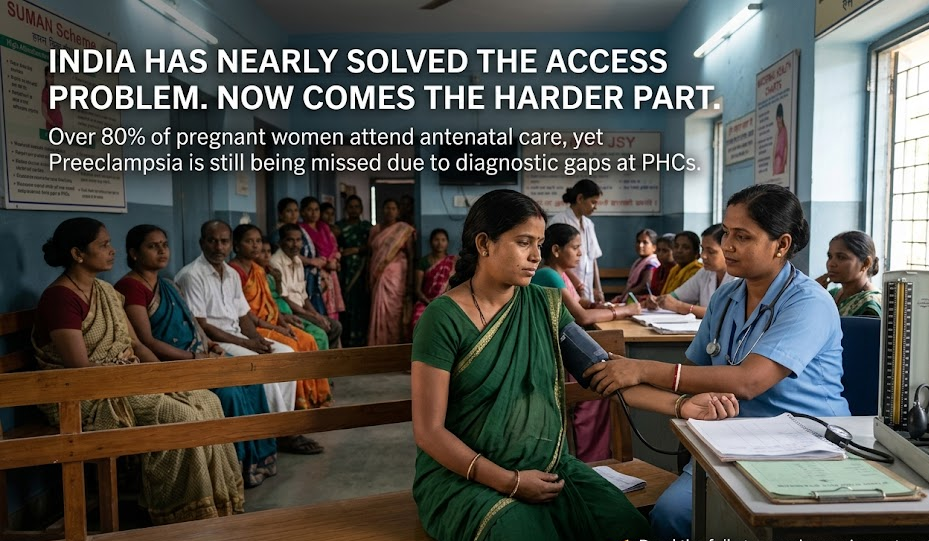
Reimagining the Rural Maternal Care Infrastructure
India’s maternal health story is one of genuine, hard-won progress. The Maternal Mortality Ratio (MMR) has declined sharply over two decades. Yet a shadow persists over rural India, where Preeclampsia — the leading cause of preventable maternal death continues to claim lives in silence. While urban centres benefit from advanced screening and tertiary care, the hinterlands tell a different story: one of missed windows, late-stage emergencies, and a quality-coverage gap that no statistic fully captures.
The Invisible Crisis: Why Preeclampsia Slips Through the Cracks
Preeclampsia is a multisystem disorder marked by high blood pressure and protein in the urine of a pregnant woman. Left undetected, it progresses to Eclampsia, seizures, organ failure, and death for both mother and child. The tragedy is that it is largely asymptomatic in its early stages. By the time a rural mother notices blurry vision, severe headaches, or swelling, the condition has often crossed into high-risk territory. Detection routinely happens only after complications have begun.
Roughly 60–70% of the rural population lacks immediate access to advanced diagnostic services. Primary Health Centres (PHCs) frequently lack calibrated equipment and a steady supply of urine protein dipsticks. Traditional quantitative protein detection requires a centralised laboratory, meaning a pregnant woman must travel miles for testing, with results delayed by three days to a week. In Preeclampsia, where a patient’s condition can deteriorate within 24 hours, this delay is fatal. In the absence of reliable lab testing, providers resort to waiting for visible symptoms: puffy faces or high BP readings. Yet medical evidence confirms that proteinuria often precedes the most dangerous spikes in blood pressure. The system waits for the fire to start before looking for a smoke detector.
Government Intent: Three Schemes Built for Every Mother
The Government of India has responded to these gaps with landmark schemes designed to reach women precisely where the system is weakest. Together, they form a policy foundation strong enough to support real, lasting change.
Janani Suraksha Yojana (JSY) — Safe Motherhood Through Institutional Delivery
Launched in 2005 under the National Rural Health Mission, JSY promotes institutional deliveries among economically weaker women through direct cash incentives — up to ₹1,400 for rural mothers in low-performing states, with an additional ₹600 for the ASHA worker who facilitates the visit. Since its inception, India’s MMR has fallen from 254 to 97 per 100,000 live births, and institutional deliveries have risen from 47% to over 88% — a transformation JSY has significantly driven.
Surakshit Matritva Aashwasan (SUMAN) — Zero-Cost, Dignified Care
Launched in 2019, SUMAN guarantees zero-expense care at public health facilities for every pregnant woman, newborn, and mother up to six months postpartum. It mandates at least four free antenatal check-ups (including one in the first trimester), free transport to and from health facilities, assured referral services within one hour of a critical emergency, and zero-cost deliveries and C-sections. The scheme enforces strict zero-tolerance for denial of services.
Pradhan Mantri Matru Vandana Yojana (PMMVY) — Financial Incentives for Health-Seeking Behaviour
Operational since January 2017, PMMVY provides ₹5,000 in two instalments for a first child and ₹6,000 for a second child (if a girl), both tied to ANC registration and immunisation milestones. By linking cash transfers directly to antenatal check-up compliance, PMMVY incentivises health-seeking behaviour and encourages women to remain engaged with the healthcare system across every ANC visit.
Taken together, these schemes represent a powerful architecture: JSY brings women into the system, SUMAN guarantees them free services once there, and PMMVY creates financial incentives to stay engaged across every ANC visit. The infrastructure of intent is in place. What has been missing is the diagnostic tool that makes each of those visits clinically meaningful.
Proflo-U®: The Missing Link in a Ready System
This is precisely where Proflo-U® enters, not as a standalone innovation, but as the clinical bridge that allows India’s existing schemes to fulfil their promise.
JSY brings mothers to the PHC. But a visit without a proteinuria screen is an incomplete visit. Proflo-U®’s point-of-care urinalysis delivers an accurate, rapid protein result at the PHC level, requiring no centralised lab and no multi-day wait. The ASHA worker who guided a mother to the facility under JSY can now ensure that the visit is diagnostically complete.
SUMAN guarantees four free antenatal check-ups. Those four visits represent four windows to detect Preeclampsia early. With Proflo-U® deployed at PHCs and sub-centres, each SUMAN-mandated visit can include a valid protein screen — transforming a coverage milestone into a genuine clinical opportunity.
PMMVY’s instalment structure is tied to ANC compliance. If those check-ups consistently include proteinuria testing, PMMVY’s financial incentives effectively become incentives for early Preeclampsia detection. A woman motivated by her next instalment to attend her check-up is a woman who can be screened, identified, and managed before a late-stage emergency develops.
The referral trap, where women arrive at district hospitals in imminent eclampsia after a bumpy ambulance journey, is not an inevitable outcome. It is what happens when the detection window is missed at the PHC. Early identification means early antihypertensive management and planned delivery, transforming what would have been a crisis into a coordinated, controlled outcome. A single ICU stay for an Eclampsia patient costs multiples of what a Proflo-U® screen costs, making point-of-care urinalysis the highest-leverage diagnostic investment available within this system.
Conclusion: Quality as the New Standard of Care
India has achieved something remarkable: over 80% of pregnant women now have institutional contact through the ANC system. JSY, SUMAN, and PMMVY have built the access. The ASHA workers are on the ground. The mothers are attending their visits.
What we owe these women now is not more coverage; it is quality. A case of preeclampsia that goes undetected across four ANC visits is not a failure of access. It is a failure of the diagnostic standard applied within that access. Closing the quality-coverage gap requires asking a harder question than “Did she attend her check-up?” It requires asking, “Was she meaningfully screened?”
By integrating Proflo-U® into the existing framework of JSY, SUMAN, and PMMVY, we can finally answer yes to that question for every mother in every village, regardless of the distance to the nearest laboratory. Early detection of Preeclampsia can reduce maternal mortality by up to 38%. That is not a statistic. That is a mother who survives. A child who is not orphaned. A family that remains whole.
The technology exists. The policy scaffolding is in place. The personnel are on the ground. What remains is a commitment to one principle: every antenatal visit must be a quality visit. That is the standard of care rural India deserves, and with the right tools, it is entirely within reach.
Key Data at a Glance
Rural Gap ~60% of rural PHCs operate with significant diagnostic equipment shortages.
Detection Window ~Early Preeclampsia detection can reduce maternal mortality by up to 38%.
Cost Advantage ~Point-of-care testing like Proflo-U® costs a fraction of an ICU stay for an Eclampsia patient.
Policy Reach ~JSY has helped drive institutional deliveries from 47% (2005) to over 88% today.