Prevention First: What the US Kidney Care National Plan Says About the Global Shift in Kidney Care
On 20 October 2026, the US Department of Health and Human Services (HHS) launched the Kidney Care National Plan, a department-wide strategy for kidney disease issued under the Make America Healthy Again initiative. It follows a pattern readers of this newsletter will recognise. A parliamentary committee in India has proposed regular kidney testing for adults, and the country's leading nephrologists have asked for CKD to be built into the national program for non-communicable diseases. European cardiologists and nephrologists have issued their first joint guideline on heart and kidney disease. Now the United States has published a plan of its own.
Three regions, three health systems, and one shared direction. This raises a fair question: why are health departments all over the world drawing up new plans for the early prevention of chronic kidney disease at almost the same moment? The answer lies in what late diagnosis costs, in lives and in money, and in the fact that the tools to find the problem earlier now exist.
What the Plan Says About the Problem
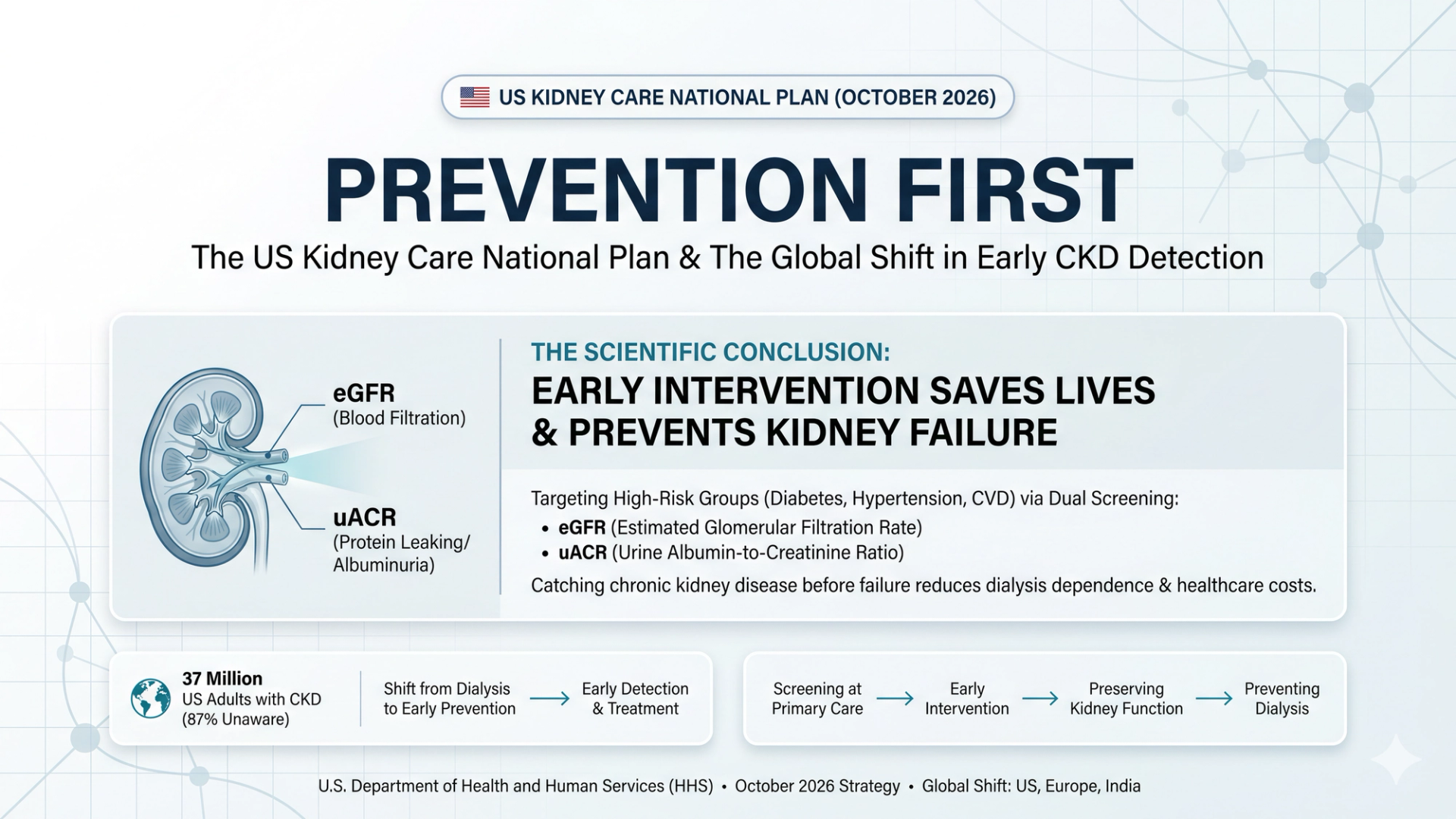
The plan opens with numbers. An estimated 37 million American adults, more than one in ten, have chronic kidney disease, and roughly 87 percent of them do not know it. Kidney disease was the eighth leading cause of death in the United States in 2024, with more than 55,000 deaths, and adults with CKD died at more than twice the rate of the general population in 2023. About 831,000 Americans were living with kidney failure that year, the stage at which the only options are lifelong dialysis or a transplant, and around 90,000 were on the transplant waiting list, many for three to five years.
The plan is blunt about what dialysis has achieved. It saves lives, yet life expectancy on dialysis has stayed flat since 2009, and fewer than half of patients are alive five years after starting. The financial picture is just as stark. People with kidney failure make up less than one percent of the US population, yet Original Medicare spent about 24.4 billion dollars on their care in 2023, and Medicare Advantage spent a further 27.7 billion. Original Medicare spent more than 141 billion dollars on beneficiaries with CKD who had not yet reached kidney failure.
The Plan's Three Areas of Focus
The plan applies one guiding idea, that government should promote competition, accountability, and innovation, to three areas.
The first is the dialysis market. The plan observes that two large companies hold roughly 74 percent of it, up from about 59 percent in 2006, and argues that regulatory structures and market concentration have slowed new entrants and new technologies. It suggests easing entry barriers, encouraging innovation, and expanding home dialysis, which reached about 16 percent of dialysis patients in 2023, up from 10.5 percent in 2017.
The second is transplantation. The plan describes organ procurement organisations that operate as regional monopolies, calls for stronger accountability and transparency, and points to early gains: between 2019 and 2023, donors rose by 21 percent and transplants by 24 percent. It also proposes strengthening living kidney donation.
The third is prevention and innovation across the whole course of kidney disease, and this is the part with the widest relevance beyond US borders. The reactions so far have been mixed in tone. Leaders of the American Society of Nephrology noted that the plan includes many priorities the society has long argued for. The largest dialysis providers welcomed the focus on prevention and home care, though DaVita disputed the plan's view that scale holds back innovation, and an industry group said that the payment system at the heart of the problem can only be changed by Congress. It is also worth remembering that the plan is a roadmap. Most of its recommendations are worded as things HHS should consider or could explore, and the detailed rules and payment models are still to come.
Why Prevention Is the Hardest Piece, and the Most Important
The plan makes an unusually candid point about why prevention is neglected. The benefits of catching kidney disease early are real but arrive years later, and they often land with a different party from the one that paid for the screening. Providers, insurers, and patients carry the immediate cost, while the savings from avoiding kidney failure accrue to Medicare many years afterwards. The result, in the plan's words, is a system with little financial reason to screen for CKD or to prevent kidney failure.
The plan sets out five ways to realign those incentives. Providers could be rewarded for keeping patients healthy across the full course of their care rather than for single episodes of treatment. Early detection could be expanded so that people at risk are found while interventions can still make a difference. A sustainable route could be built to finance new technologies aimed at preventing kidney failure. Regulators could keep working with clinicians and researchers to validate better measures of progress in kidney trials, with attention to eGFR slope and to albuminuria as a possible marker of progression in some diseases. And research funding could go toward working out how best to deliver screening to both easy- and hard-to-reach populations.
The specific recommendations follow that logic. HHS should consider a systematic evidence review of kidney disease screening in at-risk groups, including people with diabetes, hypertension, cardiovascular disease, or a family history of kidney failure. It should consider offering nutrition guidance at community health centres, developing a toolkit to help providers use the newly approved kidney therapies, exploring payment models that prioritise prevention, and convening a multi-payer summit to agree a shared approach. The plan also points to a new payment model called ACCESS, which tests payments tied to outcomes for technology-supported, proactive care of CKD and other conditions.
One honest note on scope. The plan does not name the tests that screening should use, and it does not prescribe a screening schedule. It asks for evidence and for incentives. The link to specific tests comes from the wider body of guidance around it, which we turn to next.
A Shared Conclusion Across Three Systems
Place the plan beside the developments we have covered in recent editions, and the overlap is hard to miss. In India, an estimated 138 million people were living with CKD in 2023, the Indian Society of Nephrology has warned that prevalence has passed 16 percent, and a parliamentary committee has proposed testing every adult over 20 twice a year. In Europe, the 2026 ESC guideline, developed with the European Renal Association, puts the number living with CKD at about 100 million and builds its framework on screening, triage, and staging. The World Health Organization adopted a resolution on kidney health in May 2025. In the United States, the plan counts 37 million adults with CKD, most of them unaware.
The same reasoning sits behind each of these. Kidney disease is silent in its early years. Treatments that slow it, including SGLT2 inhibitors and other newer medicines, now exist and work best when started early. And the cost of waiting is high, since dialysis is expensive, life-limiting, and disruptive to families, while a patient with early CKD and uncontrolled diabetes, as the plan puts it, is a foreseeable future case of kidney failure. We have always known that prevention is better than cure. What has changed is that governments and professional bodies are now building it into policy, funding, and guidelines.
Why the Tests Matter: eGFR and uACR
If the world is moving toward earlier detection, the next question is what to measure. The two answers that appear again and again in guidelines, in clinical practice, and in the endpoints named in the US plan are eGFR and the urine albumin-to-creatinine ratio, or uACR.
eGFR is an estimate of how well the kidneys are filtering blood, calculated from a blood creatinine test. uACR measures how much albumin, a protein that should barely appear in urine, is leaking out relative to creatinine in the same sample. The two tell different parts of the story. The ESC guideline notes that albuminuria often appears before eGFR begins to fall, which is why the spot uACR is so useful for finding kidney damage early. Together, the two numbers place a person on the KDIGO risk grid, and that placement guides what happens next: routine monitoring, closer follow-up, or timely referral to a kidney specialist. Early identification with these two tests is what makes timely referral possible, and timely referral is what keeps people on the right care pathway before kidney failure sets in.
What This Means for the Public
For readers wondering what the US plan changes in practice, the honest answer is that change will arrive gradually. The plan guides future decisions on payment, regulation, research, and oversight, and it does not itself create new entitlements or a new screening mandate. It also applies to US federal programmes, so it does not directly change care for patients in India. What it does is confirm the direction in which standards of care are travelling.
That direction has several features. People with diabetes, hypertension, heart disease, or a family history of kidney disease can expect more attention to kidney checks. Care teams are likely to be rewarded for keeping patients well, and not only for treating illness once it has progressed. Home dialysis and transplantation are set to receive more support. Public awareness efforts, including a proposed living donation campaign, are on the agenda. And newer medicines that slow kidney decline are expected to reach people earlier, because disease is found earlier.
For individuals, a few practical points hold true wherever you live. Know whether you belong to a higher-risk group. If you do, ask your doctor about two tests, eGFR and uACR, rather than a creatinine value alone. Expect to repeat them every year, in line with European guidance for people with diabetes, CKD, or heart disease. Treat a single abnormal reading as a reason for a repeat test, and as a conversation to have with your doctor, because results are confirmed over at least three months before CKD is diagnosed. In India, primary health centres and Ayushman Arogya Mandirs are the places where this kind of early testing is meant to reach people.
Where Proflo-U Fits
A policy that asks for earlier detection needs a test that can be done where people already are. The US plan itself calls for research on how to deliver screening to hard-to-reach populations, and its payment reforms depend on being able to measure whether kidney health is improving. Both ideas point to the same practical need: reliable measurement close to the patient.
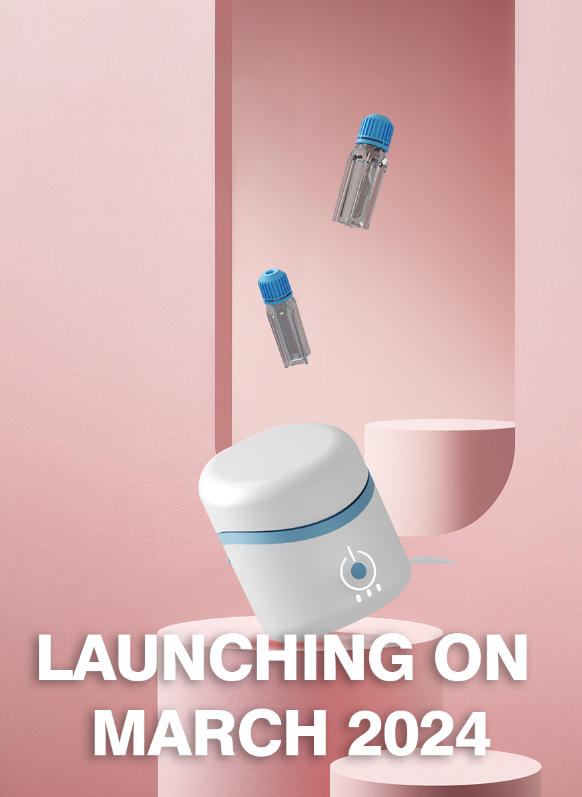
Proflo-U is our answer to that need. It is a palm-sized, battery-operated point-of-care device that delivers quantitative, lab-comparable uACR results in about four minutes, using cartridges that need no laboratory setup or cold chain and work in ambient conditions. It is CDSCO-approved, ICMR-validated, validated at AIIMS Bhubaneswar, and ABDM-compliant, and it has been deployed at primary health centres across several Indian states. Because it works at the clinic or camp, a uACR can be added to a visit that a person with diabetes or high blood pressure is already making, and the result is available before they leave. We are now extending the platform to deliver eGFR from serum creatinine alongside uACR, and developing a KDIGO-based staging heatmap that suggests a next step for the clinician to review and decide on, so that both measurements and a clear pathway can come from a single visit.
To be clear, the US plan does not mention Proflo-U or any specific device. We draw the connection because the plan, like the Indian and European policies beside it, asks the world to find kidney disease earlier, and earlier detection depends on tools that can operate beyond the walls of a central laboratory.
The Direction of Travel
A national plan, a parliamentary report, and a joint guideline are different documents written in different places, yet they have settled on the same idea: the best moment to treat kidney disease is before anyone feels unwell. Turning that idea into everyday care will take payment reform, public awareness, trained health workers, and tests that reach the last mile. The countries and companies that treat the first sign of kidney damage as the beginning of care, and not as an early warning to ignore, are the ones likely to spare the most people the long road to dialysis.
Sources: U.S. Department of Health and Human Services. Kidney Care National Plan, October 2026 (HHS Office of the Assistant Secretary for Planning and Evaluation). HHS press release, 20 October 2026. Industry and professional society reactions as reported by Healio, Fierce Healthcare, and Renal and Urology News, October 2026. 2026 ESC Guidelines for the management of cardiovascular disease and chronic kidney disease, European Heart Journal, 2026. Indian Society of Nephrology memorandum, World Kidney Day 2026.