Preeclampsia: The Next Frontier in Kidney Health Awareness
For decades, the global conversation surrounding kidney health has been dominated by a singular, looming shadow: Chronic Kidney Disease (CKD). While the focus on CKD is undeniably vital—given its role as a silent epidemic affecting millions—limiting our "renal lens" to chronic, age-related decline overlooks a critical, high-stakes arena of human health.
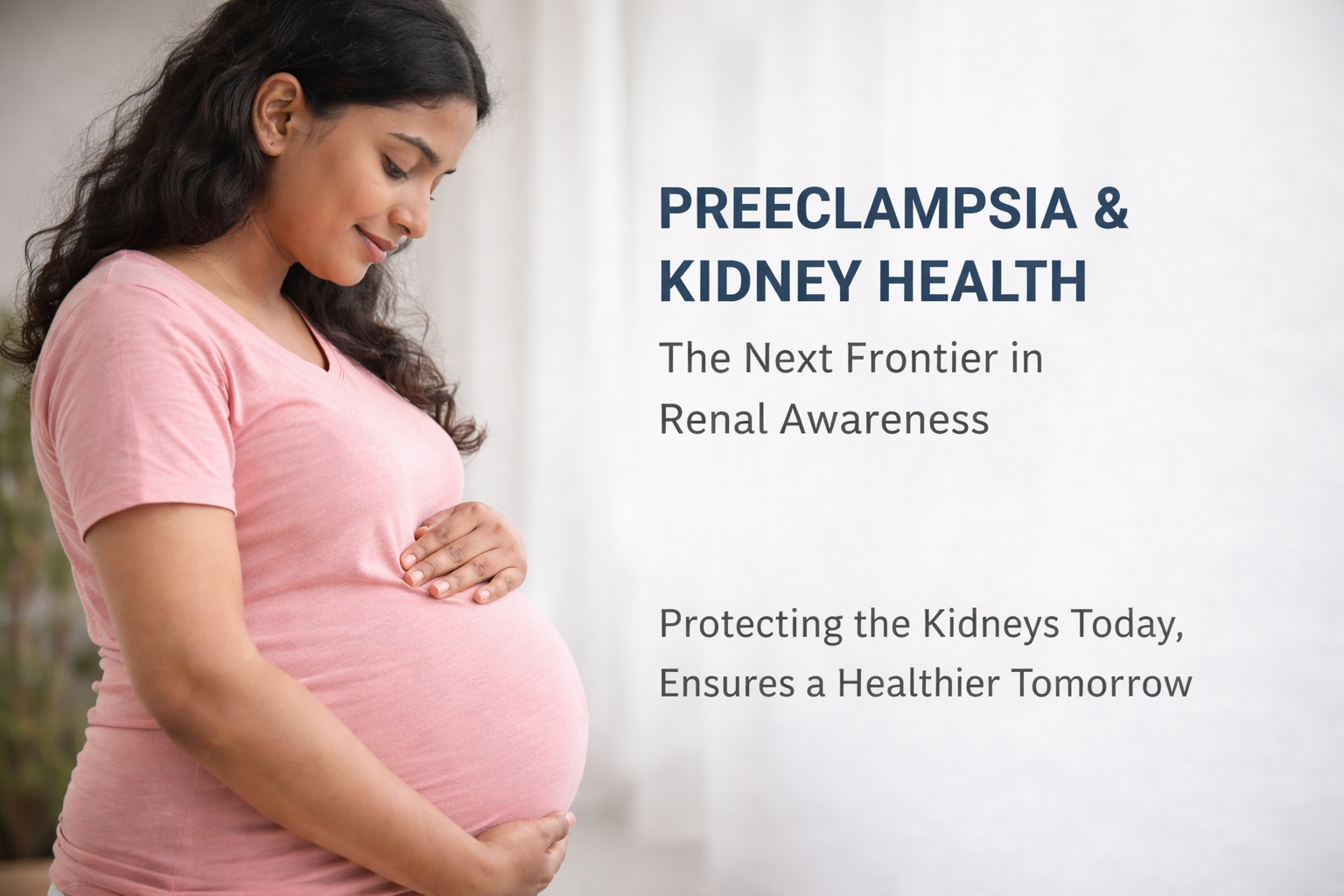
If we are to truly move beyond the traditional boundaries of nephrology, we must turn our attention to one of the most complex, rapid-onset, and dangerous manifestations of kidney stress: Preeclampsia. Often relegated solely to the domain of obstetrics, preeclampsia is, at its physiological core, a profound renal challenge. It represents a "stress test" for the kidneys that occurs in the prime of life. It is the next frontier in kidney health awareness—a condition where the kidneys act as the primary "biomarker" for a systemic storm that threatens two lives at once.
What is Preeclampsia? The Renal Connection
At its most basic clinical definition, preeclampsia is a multi-system disorder that arises after the 20th week of pregnancy. It is traditionally characterized by a "lethal duo" of symptoms: new-onset hypertension (high blood pressure) and proteinuria (the presence of excess protein in the urine).
While the root cause originates in the placenta—where abnormal blood vessel development limits oxygen and nutrient flow—the kidneys are the first major organs to suffer the systemic consequences. In a healthy pregnancy, the kidneys undergo remarkable physiological changes, increasing their blood flow and filtration rate by nearly 50% to support the growing fetus.
Preeclampsia disrupts this delicate balance. The systemic inflammation and vascular damage associated with the condition lead to glomerular endotheliosis—a swelling of the tiny filtering units of the kidney. This damage makes the kidneys "leaky," allowing essential proteins like albumin to escape into the urine. In this context, the kidney isn't just an affected organ; it is a sentinel, providing the earliest measurable signs that a pregnancy is veering toward danger.
The Weight of the Crisis: Global and Indian Burden
Preeclampsia is not a rare complication; it is a leading cause of maternal and perinatal morbidity and mortality worldwide. The statistics paint a picture of a crisis that demands urgent innovation.
The Global Picture
Preeclampsia affects approximately 2% to 8% of all pregnancies globally. According to the World Health Organization (WHO), hypertensive disorders of pregnancy are responsible for over 70,000 maternal deaths and 500,000 fetal deaths annually. It is a leading cause of premature births, often forcing clinicians to deliver babies weeks or months early to save the mother's life.
The Indian Context
In India, the burden is significantly higher due to diverse socio-economic factors and varying access to early antenatal care.
- Incidence: Studies suggest that the incidence of preeclampsia in India ranges from 8% to 10%, significantly higher than the global average.
- Mortality: Hypertensive disorders are a primary contributor to the country's Maternal Mortality Ratio (MMR), particularly in rural pockets where monitoring is infrequent.
- The "Double Burden": With rising rates of gestational diabetes and pre-existing hypertension in the Indian population, the "renal reserve" of many expectant mothers is already compromised, making them more susceptible to severe preeclampsia.
The risks are twofold. For the mother, undiagnosed preeclampsia can escalate into Eclampsia (seizures), organ failure, or stroke. For the fetus, it often leads to Intrauterine Growth Restriction (IUGR) and long-term developmental challenges.
The "Silent" Threat: Why Early Detection is Elusive
Much like CKD, preeclampsia is frequently labeled a "silent condition." In its early stages, a pregnant woman may feel perfectly fine. The subtle signs—slight swelling of the hands or face, a mild headache, or subtle vision changes—are often dismissed as "normal pregnancy discomforts."
By the time "loud" symptoms appear—such as severe epigastric pain, persistent vomiting, or neurological distress—the condition has often progressed to a critical stage where emergency intervention is the only option.
The Role of Proteinuria in Early Detection
Because physical symptoms are unreliable, the role of kidney dysfunction markers becomes paramount. Proteinuria is the hallmark of the disease. Specifically, monitoring the uACR (Urine Albumin-to-Creatinine Ratio) allows clinicians to detect minute amounts of albumin (microalbuminuria) long before a standard "dipstick" test might show a positive result.
Early screening isn't just about diagnosis; it’s about risk stratification. Identifying renal stress early allows for:
- Timely intervention: Starting low-dose aspirin protocols early in pregnancy (ideally before 16 weeks) for high-risk patients.
- Closer monitoring: Increasing the frequency of check-ups to catch blood pressure spikes.
- Resource planning: Ensuring the mother is near a facility with a Neonatal Intensive Care Unit (NICU) should an early delivery become necessary.
The Diagnostic Gap: Moving Toward the Point of Care
Despite our understanding of the disease, current diagnostic pathways face significant limitations, especially in decentralized healthcare settings:
- Inaccuracy of Dipsticks: Standard urine dipsticks, used in most primary health centers, are notorious for high "false positive" and "false negative" rates. They are affected by urine concentration, meaning a dehydrated patient might show a false alarm, while a well-hydrated patient with significant protein loss might be missed.
- Delayed Lab Results: The "gold standard" 24-hour urine protein collection is cumbersome and delayed. In a condition as volatile as preeclampsia, waiting 24–48 hours for a lab result is a luxury patients don't have.
- The Urban-Rural Divide: In rural India, a pregnant woman may have to travel hours to reach a laboratory capable of performing precise renal chemistry. This barrier leads to missed appointments and "lost" opportunities for early detection.
To bridge this gap, we need decentralized, point-of-care (PoC) solutions that provide lab-quality accuracy at the bedside.
The Future: Integrated Markers and AI Prediction
As we look toward the future of maternal-renal health, the landscape is becoming increasingly data-driven and proactive. The "Next Frontier" will likely involve:
- Integrated Renal Profiles: Moving beyond just protein to include pregnancy-specific eGFR (estimated Glomerular Filtration Rate). By looking at both damage (uACR) and function (eGFR), clinicians can get a 360-degree view of how the mother’s kidneys are coping with the pregnancy.
- AI-Enabled Risk Prediction: The integration of diagnostic data into AI models will allow us to predict preeclampsia weeks before it manifests. By analyzing blood pressure trends, uACR levels, and maternal history, AI can flag high-risk mothers for specialized care long before they become symptomatic.
- The "Fourth Trimester" and Beyond: We now know that women who have had preeclampsia have a 3-to-4 times higher risk of developing Chronic Kidney Disease (CKD) later in life. The future of diagnostics will focus on long-term monitoring, using pregnancy data to protect a woman's kidney health for decades after she has given birth.
Conclusion: A Call for Focused Attention
Preeclampsia is not just a complication of pregnancy; it is a critical window into the lifelong health of two generations. For too long, we have treated kidney health as a concern reserved for the elderly or those with long-standing diabetes. It is time to recognize that the most acute and life-altering kidney challenges often happen in the maternity ward.
By framing preeclampsia as the "next frontier" in kidney health, we acknowledge a vital truth: the health of the kidney is the health of the mother. We have the technology, the markers, and the innovative tools like Proflo-U® to change the narrative from one of tragedy to one of prevention.
Preeclampsia deserves our focused attention because it is the ultimate test of renal resilience—and in this test, there is no room for delay. Protecting the kidneys today ensures a healthier tomorrow for both mother and child.