Diagnostics, Digitized
She almost let it ring a second time.
Dr. Ananya was mid-sentence at the front of a lecture hall at a Medical Science institute in Kochi — a guest faculty slot she had been invited to fill, addressing a room of second-year medical students who had spent the morning leaning forward with the particular alertness of people encountering real clinical thinking for the first time. She was walking them through a complex case of gestational hypertension she had managed earlier that year, the kind of case that doesn't resolve neatly and teaches you more than a textbook chapter ever could, when her phone lit up on the podium.
The name on the screen was Sulochana, her clinic nurse back in Thrissur.
Dr. Ananya glanced at it and kept talking. Sulochana would leave a message if it wasn't urgent. The students were engaged. She had forty minutes left on the clock.
But the phone rang again.
She held up one hand to the class for one moment and stepped to the side of the room.
"Ma'am, a new patient has walked in," Sulochana said, her voice carrying the careful steadiness of someone trying not to sound alarmed. "She's pregnant, maybe seven months. She came in saying she's had a headache since yesterday. BP is 152 over 98. Her face and hands are swollen. Her husband is very worried, ma'am. He drove her all the way from Palakkad this morning."
Dr. Ananya did not need Sulochana to say anything further. The symptom triad was familiar — and it was not one she could afford to dismiss.
"Get a uACR done on her right now," she said. "Use the Proflo-U. Call me the moment the result is ready."
She returned to the podium. Forty pairs of eyes tracked her across the room. The hall had grown perceptibly quieter. And then, as she had fully expected, the murmuring started the low, animated hum of students working through a differential diagnosis in real time. She caught fragments drifting up from the rows. Could be gestational hypertension. What about HELLP syndrome? Sounds like eclampsia to me. No, no, BP isn't high enough for that.
She smiled. "I can hear you," she said. "And I'll tell you what's happening in a few minutes. Right now, we wait for a test result."
Four minutes, to be precise.
When the phone rang again, she picked it up immediately. No one in the hall could hear what the caller was saying — but they watched her listen, watched the slight shift in her posture as the numbers came through, and then heard her speak with complete clinical certainty.
"She's pre-eclamptic," Dr. Ananya said into the phone. "Start monitoring her and begin the medication protocol. Get her to lie down, monitor the foetal heart rate as well, and make observations every 15 minutes. I'll be back by evening and will see her myself, but she needs to be closely watched until then."
She ended the call. The lecture hall was very still.
The student in the third row, earnest, glasses slightly too large for her face, raised her hand before Dr. Ananya had even set the phone down. "Ma'am, how could you be so sure? Just from a phone call?"
"Not from the phone call," Dr. Ananya said. "From the report."
She turned her phone screen toward the class and pulled up the Proflo-U app. The result was already there a sharply elevated urine albumin-to-creatinine ratio, generated and transmitted to her phone within minutes of the test being completed at her clinic, 480 kilometres away.
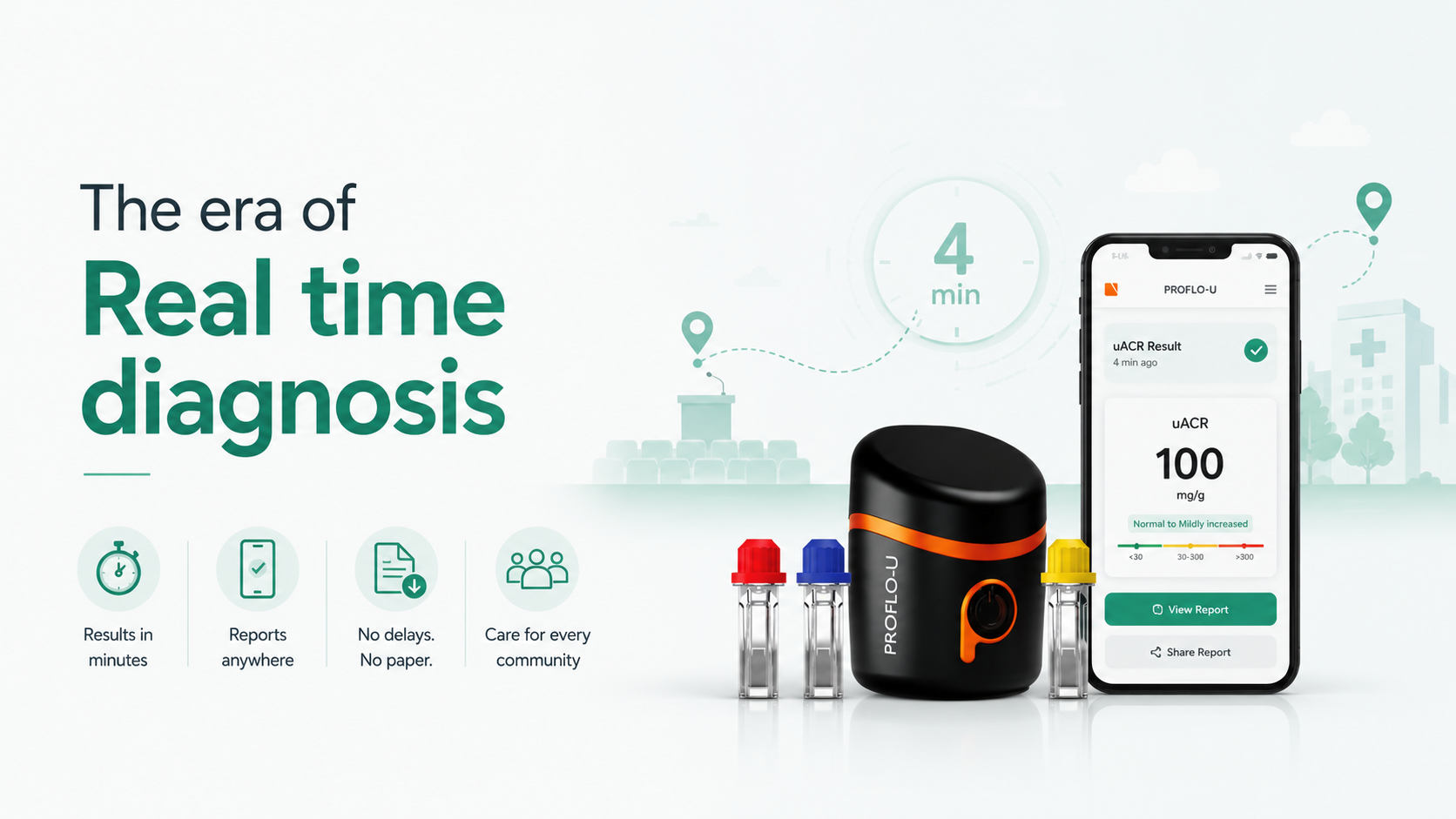
"We installed Proflo-U at our clinic earlier this year," she told them. "It is a point-of-care renal diagnostic device that measures uACR accurately and generates a digital report in four minutes. The moment my technician ran the test, the result appeared on the app and was sent directly to me. It will also be downloaded and given to the patient so she can share it with any specialist she consults going forward. No waiting. No paper. No delay."
The student with the glasses leaned forward slightly. "So you diagnosed a patient in Thrissur while standing in a lecture hall in Kochi."
"The Proflo-U gave us the answer," Dr. Ananya said. "I just read the report."
The hall laughed — the easy, relieved laughter of people who had been quietly holding their breath.
But she meant it seriously, and she said so. This, she told them, is the direction Indian healthcare is moving toward: accurate, point-of-care diagnostics with instant digital reporting, where the quality of the test does not depend on the proximity of the doctor, and where a result that might take hours or days, in some settings, now takes four minutes without any compromise on precision. That patient's husband, who drove her in from Palakkad at the first sign of trouble, the nurse who acted without hesitation, the technician who ran the test immediately each of them did their part. The technology made sure the result reached the doctor before the situation could deteriorate.
Medicine, she said, has always been about closing the distance between a patient and an answer. We are finally building tools that make that distance irrelevant.
The Gap That Grew in Silence
Kidney disease is one of the most quietly devastating conditions in modern medicine. It affects an estimated 850 million people worldwide, and in India alone, the burden is staggering, compounded by the fact that the majority of those affected will not know it until the disease is already advanced. Unlike a fever or a fracture, early-stage chronic kidney disease (CKD) announces itself in whispers: mild fatigue, occasional swelling, a blood pressure reading that creeps upward. These are symptoms that busy, overstretched individuals in rural and semi-urban India routinely dismiss — or simply never get tested for.
The structural problem runs deeper than awareness. For a patient in a small town in Vidarbha, Bundelkhand, or interior Odisha, accessing a nephrology consultation is not a matter of booking an appointment. It means a day's travel, wages lost, children left behind, and a paper report that might be misplaced, illegible by the time it reaches a specialist, or simply arrive too late to change the clinical outcome. For pregnant women already at risk, these delays are not inconvenient — they are dangerous.
Late diagnosis in CKD is not an anomaly. It is the norm. And the gap between when kidney damage begins and when it is caught has, for millions of patients, been quietly measured in years.
What the uACR Test Actually Tells Us
At the centre of early kidney disease detection is a deceptively simple measurement: the urine albumin-to-creatinine ratio, or uACR. The test works by detecting albumin, a protein in the urine. Healthy kidneys keep albumin in the bloodstream where it belongs. When kidney function is compromised, the filtration barrier breaks down, and albumin begins to leak into the urine. Even small amounts of this leakage, known as microalbuminuria, are a reliable early warning signal — often detectable years before kidney function visibly deteriorates on standard blood tests.
For patients with diabetes, hypertension, or in the case of pregnant women, hypertensive disorders like preeclampsia, elevated uACR can be the earliest objective indicator of organ damage. It is non-invasive, requires only a small urine sample, and is critically actionable. A high result does not mean irreversible damage has occurred; it means there is still time to intervene. That is precisely why the uACR is widely regarded as the gold standard for early CKD detection and monitoring.
The question has never really been whether to test. The question has always been: how do we make this test accessible to every patient who needs it?
When the Report Goes Digital
The logistics of diagnostic reporting in India have long been a quiet, underappreciated obstacle to timely care. Paper reports get collected days after the test. They travel in handbags and shirt pockets, sometimes crumpled, sometimes lost. Patients arrive at specialist consultations without them. Physicians in remote settings send samples to urban labs and wait sometimes for days before results trickle back through WhatsApp photographs or hand-delivered envelopes. In this environment, "early diagnosis" remains more aspiration than practice.
The digitisation of diagnostic reports is not a cosmetic upgrade to this system. It is a structural correction. When results are generated digitally and made instantly accessible through a smartphone application, the entire chain collapses in the best possible way. There is no collection window. There is no delay in transit. There is no risk of a lost envelope changing the course of a patient's care.
This is the shift that tools like Proflo-U are making real.
Four Minutes, One Screen, One Decision
Proflo-U was designed around a straightforward premise: the clinician who needs a result and the patient generating that result should not be separated by logistics.
When a uACR test is run using the Proflo-U system, results are ready in approximately four minutes. They appear immediately within the app, visible to the healthcare provider in real time — whether they are seated across from the patient or standing at a lecture podium in another city entirely. The report can be downloaded directly from the app and shared with the patient, their family physician, or a specialist consultant, without a single piece of paper changing hands.
For a community health worker running an antenatal screening camp in a rural block of Madhya Pradesh, this means that a pregnant woman with elevated albumin levels does not leave the camp with a vague instruction to "follow up." She leaves with a result, a downloaded report on her phone, and a clear referral pathway already initiated. For a general practitioner in a tier-three town managing a diabetic patient with suspected kidney involvement, it means a specialist in the nearest city can review the result within minutes and advise on management without the patient making that journey — yet.
India's own policy architecture is beginning to reflect this understanding. The Ayushman Bharat Digital Mission, better known as ABDM, is the Government of India's flagship initiative to build a unified digital health ecosystem for the country, one in which every citizen's health records, diagnostic reports, prescriptions, and clinical history are linked through a single, secure health identifier. The vision is significant: a patient who is tested in a rural health center in Chhattisgarh should be able to walk into a specialist clinic in Chennai and have their complete medical record accessible in seconds, without carrying a single document.
Proflo-U's platform seamlessly integrates with this infrastructure, ensuring point-of-care uACR results are instantly uploaded into a patient's centralized, ABDM-linked history. By solving India's long-standing challenge of fragmented medical data, this interoperability shifts the paradigm away from delayed or duplicated diagnoses and toward the continuous, long-term tracking vital for early chronic kidney disease (CKD) detection.
This is what equitable diagnostics can look like.
The Larger Movement We Are Part Of
In May 2025, the World Health Organization formally adopted its first-ever resolution on kidney health at the 78th World Health Assembly — a landmark moment that placed CKD, for the first time, on the official global NCD agenda. The resolution called on member states to prioritise early detection, strengthen primary care, and expand access to diagnostics. Months later, the first Global Pre-eclampsia Summit in Kigali, convened by WHO and HRP, echoed the same urgent logic for maternal kidney health: that the tools exist, that the evidence exists, and that what has been missing is the infrastructure and the will to deliver them equitably.
Proflo-U is not simply a faster way to run a urine test. It is a piece of the infrastructure that these global commitments demand — the point-of-care, mobile-accessible, instantly shareable diagnostic layer that can finally bring early kidney health detection within reach of every patient, in every community, regardless of how far they live from the nearest hospital.
The patients who need this most are not those in metro cities with reliable internet, air-conditioned clinics, and same-day specialist access. They are the woman from Palakkad whose husband drove her in with a headache that turned out to be a warning sign — and the countless others in underserved communities who never make it to the clinic at all, because the distance between them and a diagnosis has always felt insurmountable.
Technology cannot replace human care at the end of that journey. But it can make sure the answer arrives before it is too late.
And sometimes, it arrives in the middle of a lecture.