
CKD of Unknown Origin: The Silent Kidney Crisis Spreading Through India's Farmlands
Not all chronic kidney disease follows a familiar path. Most people associate kidney failure with diabetes or high blood pressure, conditions that slowly damage the kidneys over years and are, at least in theory, manageable if caught early. But across several of India's agricultural states, a different and far more puzzling form of kidney disease has been quietly spreading, one that affects people who often have neither diabetes nor hypertension, sometimes striking them young, and, most troublingly, has no single confirmed cause. Doctors call it Chronic Kidney Disease of unknown etiology, or CKDu.
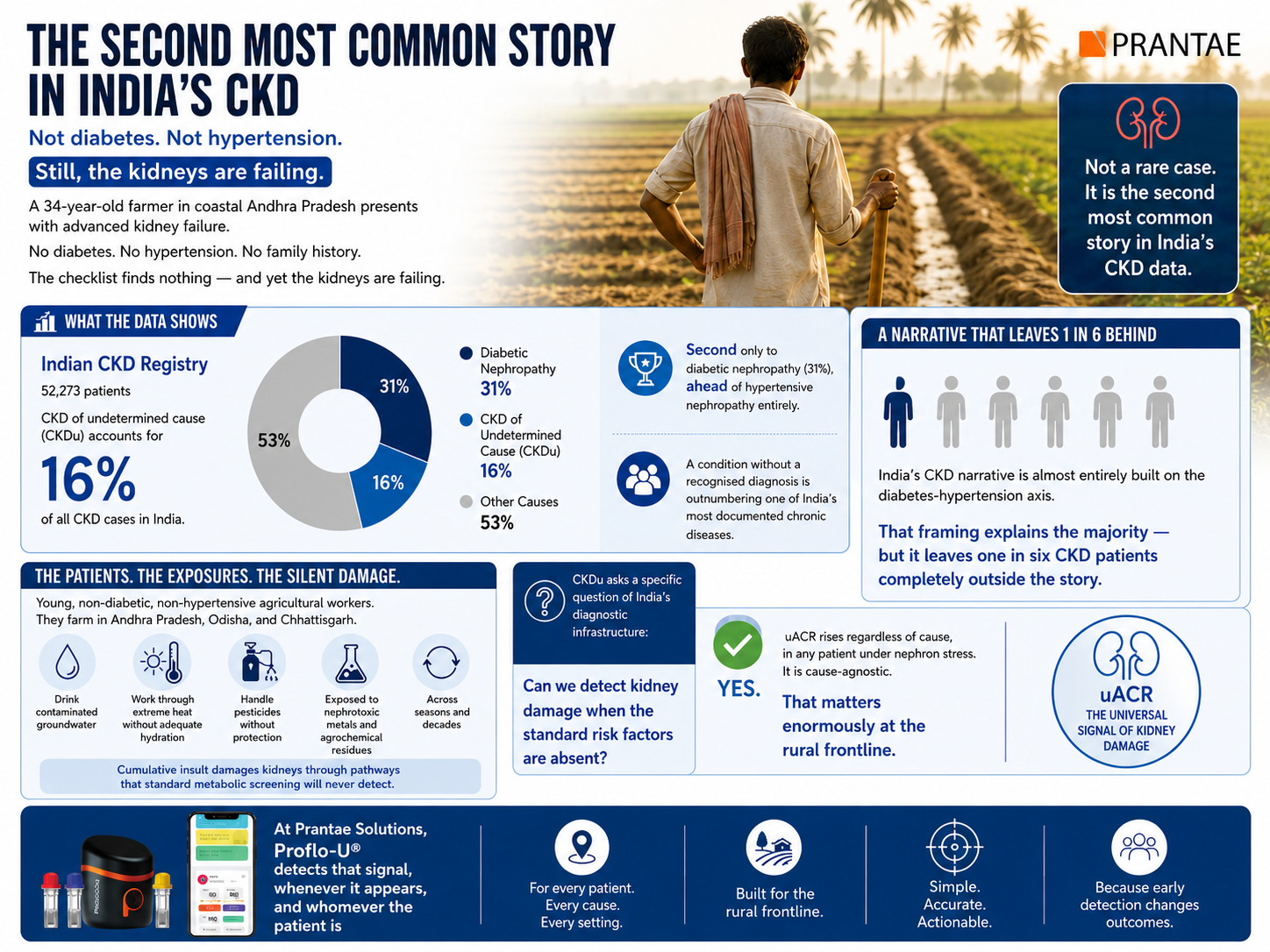
This is not a fringe medical curiosity. According to the Indian CKD Registry, which analysed data from over 52,000 adult patients across the country, CKD of undetermined origin accounts for 16 percent of all chronic kidney disease cases in India, making it the second most common category after diabetic nephropathy, which accounts for 31 percent. To put that in perspective, CKDu is now a bigger contributor to kidney failure in India than either chronic glomerulonephritis or hypertension-related kidney damage, two causes that have received far more clinical attention and public awareness over the decades.
A Disease That Behaves Differently
What makes CKDu particularly concerning is not just how common it has become, but who it affects and how it tends to be discovered. The same national registry data shows that patients with CKD of unknown origin tend to be younger than those with diabetic kidney disease, are more frequently women, and are significantly more likely to be diagnosed only once the disease has already reached its most advanced stage. In other words, by the time most people with CKDu are identified, meaningful treatment options have already narrowed considerably.
This pattern is not unique to India. Similar clusters of unexplained kidney disease have been documented for decades among agricultural communities in Central America, where the condition is known as Mesoamerican nephropathy, and in Sri Lanka, where it was first formally described in the 1990s. In India, well-documented hotspots have emerged in the Uddanam region of Andhra Pradesh's Srikakulam district, in parts of Odisha, and in agricultural belts of Goa, Maharashtra, and Tamil Nadu. In Uddanam alone, local health authorities had recorded an estimated 34,000 cases and around 4,500 related deaths by 2015, a scale significant enough that the condition earned its own local name, Uddanam nephropathy.
What Seems to Be Driving It
Because CKDu is defined largely by the absence of the usual suspects, diabetes, hypertension, or known hereditary kidney disorders, researchers have had to work backward from patterns in the affected communities to identify likely contributing factors. Three themes recur across Indian studies.
The first is water and soil contamination. Several studies have detected elevated levels of silica in groundwater in CKDu hotspots, along with residues of agrochemicals, such as pesticides and fertilisers, that have been used intensively in these farming regions for decades. Because rural communities in these areas often rely on shallow wells or groundwater with limited treatment, exposure through daily drinking water is considered a strong candidate explanation.
The second is extreme heat. India's agricultural hotspots for CKDu tend to be in regions that already experience punishing temperatures for much of the year, and researchers studying districts such as Bargarh in Odisha have found that the areas with the highest heat stress also had the highest rates of CKDu. When the body is repeatedly exposed to extreme heat without adequate fluid replacement, it can trigger repeated, low-grade episodes of dehydration-related kidney injury. Over years, these repeated small injuries are thought to accumulate into permanent, irreversible scarring within the kidney's filtering tubules, a pattern confirmed on biopsy in affected patients, distinct from the type of damage typically seen in diabetic or hypertensive kidney disease.
The third is the nature of agricultural labour itself. Long hours of physically demanding outdoor work, often without regular breaks, shade, or consistent access to drinking water, compound the heat exposure problem. Research from Tamil Nadu found that the number of weekly hours spent working outdoors was itself significantly associated with higher CKD rates among agricultural workers, independent of other risk factors. Poor access to formal education and lower income levels were also linked to higher risk, likely reflecting broader gaps in awareness, healthcare access, and working conditions.
Why Standard Screening Approaches Are Failing These Communities
Most kidney disease screening programmes are built around known risk factors: people with diabetes or high blood pressure are flagged for regular kidney function checks, because doctors know to look for kidney damage in these groups. CKDu breaks this model entirely. The people most at risk are often young, otherwise healthy-looking agricultural workers with no diabetes or hypertension, precisely the population that routine screening systems are least likely to test in the first place. Combined with limited healthcare infrastructure in many of these rural farming belts, this means the disease is frequently discovered only once symptoms of advanced kidney failure appear, by which point irreversible damage has already been done.
What Can Actually Be Done
Addressing CKDu requires action on two fronts at once: reducing the underlying exposures that appear to be driving the disease, and catching it far earlier in people who are already at risk.
On the exposure side, the most immediately actionable step is protecting agricultural workers from the conditions that seem to be causing repeated kidney injury. This means structured hydration protocols during work hours, ensuring workers have consistent access to safe drinking water and oral rehydration solutions rather than relying on whatever is available nearby, and adjusting work schedules to reduce direct exposure during the hottest parts of the day wherever possible. Providing shaded rest areas and building in regular breaks during long shifts can meaningfully reduce the cumulative heat and dehydration burden on the body. Alongside this, testing and improving groundwater quality in known hotspot districts, and encouraging safer agrochemical handling and storage practices, could help address the contamination side of the equation, though this will require sustained investment from local health and agricultural authorities rather than individual behaviour change alone.
On the healthcare side, the single most important shift needed is moving away from symptom-triggered testing toward proactive, population-level screening in known high-risk districts, regardless of whether a person has diabetes or hypertension. Given that CKDu tends to be discovered late precisely because it doesn't fit the usual screening triggers, health systems serving these agricultural regions need standing screening programmes built around occupation and geography rather than conventional risk factors alone.
Where Early Diagnostics, and Proflo-U, Fit Into the Solution
This is precisely where accessible, point-of-care diagnostic tools can change the trajectory of this disease. The biggest barrier to catching CKDu early in India's farming communities has never really been a lack of medical knowledge about what to look for. It has been the practical difficulty of testing large numbers of otherwise healthy-looking agricultural workers in areas where the nearest diagnostic laboratory may be hours away. A screening programme that depends on sending samples to a distant lab and waiting days for results simply does not scale to the kind of routine, community-wide testing that CKDu prevention actually requires.
Prantae Solutions' Proflo-U was built to close exactly this gap. By enabling accurate urine albumin-to-creatinine ratio testing directly at the point of care, whether at a primary health centre, an occupational health camp, or during a community screening drive in a district like Bargarh or Srikakulam, it becomes realistic to test agricultural workers where they already are, without asking them to travel or wait. Since kidney damage in CKDu often shows up as early tubular injury well before a person feels unwell, a tool capable of flagging that damage in minutes, rather than days, gives health workers and local institutions the ability to identify at-risk individuals while there is still meaningful room to intervene, whether through closer monitoring, workplace changes, or referral for further evaluation. Empowering primary health centres and occupational health programmes in these districts with this kind of accessible diagnostic capability does not just improve individual outcomes; it gives an entire region the tools to finally screen for a disease that has, until now, largely gone undetected until it was too late to reverse.
A Disease That Reflects the Conditions People Work In
CKDu is, in many ways, a disease written by geography, occupation, and circumstance rather than by any single pathogen or gene. It affects the people who grow the country's food, working long hours under conditions that few of the rest of us ever have to endure. Treating it seriously means treating both halves of the problem with equal urgency, changing the conditions that appear to be causing it, while making sure that no farmer has to wait until their kidneys have already failed to find out something was wrong in the first place.