
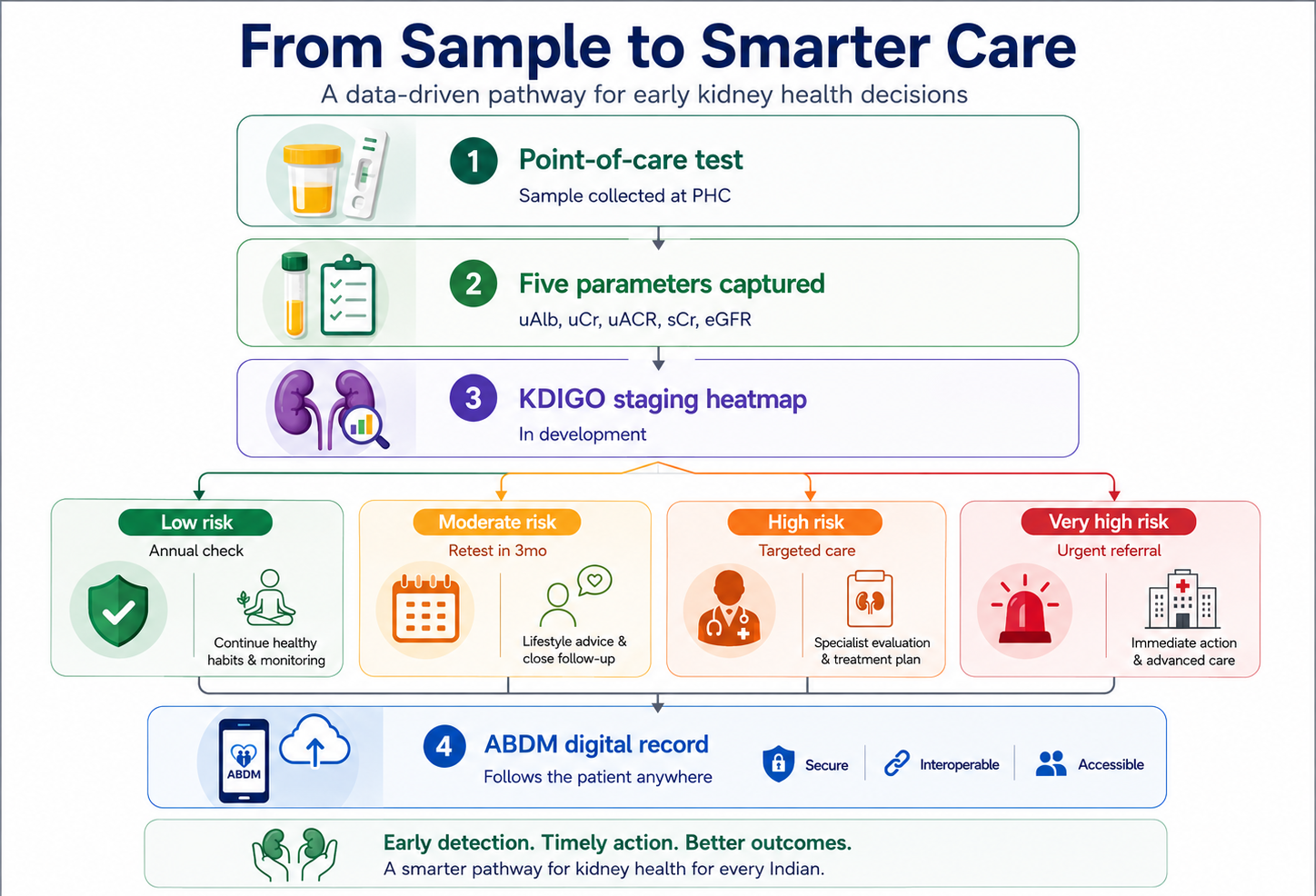
Building the Last Mile: How Digital Health Infrastructure Is Reshaping Care in India
or most of India's healthcare history, a patient's medical record has lived in one place at a time: a folder in a specific clinic, a stack of prescriptions carried by hand, a discharge summary that exists nowhere except the hospital that issued it. The moment a patient moved cities, changed hospitals, or needed urgent care somewhere unfamiliar, that history effectively disappeared with them. This is not a minor administrative inconvenience. It has, for decades, meant repeated tests, lost context, delayed treatment, and decisions made without the full picture, all because information could not travel as easily as the patient needed it to.
India has spent the past several years quietly building the infrastructure to change that, and at the centre of it sits the Ayushman Bharat Digital Mission, or ABDM. It is, in many ways, the single most consequential piece of digital health infrastructure the country has built, precisely because it is not really about any one hospital, app, or device. It is about the connective layer underneath all of them.
What is ABDM
ABDM is implemented by the National Health Authority, an agency of the Government of India, and its purpose is to develop the digital backbone necessary to support an integrated healthcare infrastructure across the entire country. In practical terms, this means building a common set of digital standards and identity systems that allow every stakeholder in India's healthcare ecosystem, such as hospitals, primary health centers, diagnostic labs, pharmacies, insurers, and individual patients themselves, to securely exchange health information regardless of where each of them happens to be.
At the core of this system are a few interlocking pieces. Every individual can obtain a unique Health ID, a portable digital identity that follows them across the healthcare system rather than being tied to a single hospital's internal records. Health facilities and healthcare professionals are registered within national registries, giving the system a verified map of who is providing care and where. A Unified Health Interface allows different digital health platforms, whether built by public hospitals, private diagnostic companies, or government programmes, to interact with one another using shared, interoperable standards, rather than existing as disconnected islands that cannot talk to each other.
The mission's stated goal is to bridge the gaps that have historically existed between different stakeholders in India's healthcare ecosystem, linking practitioners and patients digitally so that real-time health records become accessible at the point of care, wherever that point of care happens to be. This is meant to promote healthcare that is, in the mission's own framing, efficient, accessible, inclusive, affordable, timely, and safe, values that sound aspirational in the abstract but translate into something very concrete for the people this infrastructure is ultimately built for.
What This Means for the Masses
It is worth pausing on what this looks like in practice, because the value of a digital health backbone is easy to underestimate until you consider the alternative it is replacing.
Consider a patient in a smaller town who is screened at a local primary health center and later needs to see a specialist in a larger city, whether by choice or referral. Under the old model, that patient typically arrives at the specialist's office carrying whatever paper records they remembered to bring, if any, and the specialist begins largely from scratch, often reordering tests that were already done simply because there is no reliable way to access the original results. Under an ABDM-linked system, that same patient's prior test results and clinical history can, in principle, be securely accessed by the receiving specialist directly, without duplication, without delay, and without depending on the patient's memory or paperwork.
This matters just as much, if not more, in emergencies. A patient brought into an unfamiliar hospital following an accident, with no ability to communicate their medical history themselves, benefits enormously from a system where their existing health record, allergies, chronic conditions, and current medications can be retrieved quickly by the treating team rather than reconstructed under pressure. It matters for continuity of chronic disease management too, where a patient managing a long-term condition across multiple providers no longer has their care fragmented simply because different parts of it happened in different places. And at a system level, it matters for public health programs themselves, which depend on accurate, consolidated data to understand where disease burden is concentrated and where resources need to be directed, something that has historically been extremely difficult to do well across a healthcare system as vast and fragmented as India's.
None of this requires patients or providers to change how they think about healthcare. It simply requires the infrastructure underneath their existing interactions to finally talk to itself, and that, quietly, is what ABDM has been built to do.
Why We Made This a Priority
As an Indian company building an indigenously developed diagnostic product from the ground up, we did not want to be a company standing outside this digital transformation while the rest of the country's healthcare system moved forward without us. After months of development, testing, and demonstration, we are proud to share that Prantae Solutions is now ABDM compliant, having successfully achieved Milestones M1 and M2.
This certification reflects a deliberate decision about what kind of company we want to be within India's healthcare ecosystem: one where the diagnostic results our platform generates do not remain isolated readings that live and die within a single clinic visit, but results capable of becoming part of the same connected, portable health record architecture the rest of the country's healthcare system is being built around.
How the People Using Our Device Benefit From This Upgrade
It is worth being specific about what ABDM compliance changes for the people on the ground, because the value of this kind of integration is easy to describe abstractly and much more meaningful when grounded in who actually benefits.
For the health worker or operator conducting a test at a primary or community health centre, ABDM compliance means the results generated on our platform are structured in a way that is built to plug into the same national digital health infrastructure the rest of the system increasingly runs on, rather than existing as a one-off reading that has to be manually transcribed, reported, or reconciled separately. This reduces duplicate administrative work and makes it easier for that health worker's testing activity to feed cleanly into broader screening and reporting requirements, including government-run non-communicable disease programmes that increasingly expect this kind of digital traceability.
For the referring doctor or specialist further along the patient's care journey, it means a test result generated at a primary health centre days or weeks earlier does not have to be recreated from scratch, or taken on faith from a patient's verbal account, once that patient reaches them. It can, in principle, travel as part of the patient's connected health record, giving the specialist a fuller, more accurate picture of a patient's kidney health history the moment they begin the consultation, rather than starting from zero.
And for the patient themselves, it means a screening result is not something that simply disappears once they leave the health centre where it was generated. It becomes part of a record that can follow them, whether they are referred to a specialist in another city, seek a second opinion, or simply need their own health history accessible the next time they interact with the healthcare system. For a patient in a rural or semi-urban setting, who may not have consistent access to the same clinic or the same doctor over time, this portability is not a convenience. It is often the difference between continuity of care and having to start over every time circumstances change.
The Next Leap Sitting on Top of This Foundation
ABDM solves the problem of moving health information reliably from one point to another. It does not, on its own, solve the separate problem of what should happen with that information once it arrives, particularly at the primary care level, where the person reviewing a result may not have specialist training to interpret it fully. This is where a second wave of digital transformation is already beginning to take shape across Indian healthcare, and it is worth understanding in outline even if it is not yet the main story.
Across nephrology specifically, recent research has shown genuinely strong progress in using artificial intelligence and machine learning to predict outcomes like acute kidney injury, chronic kidney disease progression, and complications during dialysis. These models are increasingly capable of flagging which patients are likely to progress rapidly toward kidney failure, or which dialysis patients are at risk of a dangerous complication, well before those events would otherwise become clinically obvious. The direction this research is heading is clear: AI-driven decision support, built thoughtfully and kept firmly under clinical oversight, is becoming a genuinely credible part of how kidney disease, and chronic disease more broadly, will eventually be managed in India.
What makes this connect back to ABDM rather than exist as a separate story is that predictive models of this kind become substantially more powerful once they have continuous, longitudinal patient data to work with, rather than a single isolated test result. A connected health record, the kind ABDM is designed to enable, is precisely the foundation that makes this next generation of AI-supported care realistic at national scale, rather than confined to well-resourced hospitals with their own internal data systems. In this sense, ABDM is not simply solving today's problem of fragmented records. It is quietly building the infrastructure that tomorrow's smarter, more predictive tools will eventually depend on.
Where We See Ourselves in This Story
Our ABDM compliance is, in that sense, only the first step of a longer commitment. Having built the ability to plug our diagnostic results into India's national digital health infrastructure, we see this as the foundation for everything that follows, including the more intelligent, decision-supportive tools the broader field of AI in nephrology is now actively working toward. Getting the connectivity right first is what will eventually make those more advanced capabilities genuinely useful at scale, rather than isolated features that never quite reach the patients who need them most.
A Foundation, Not a Finish Line
It would be easy to treat ABDM compliance as a single achievement to announce and move past. We see it differently: as one step in a longer effort to ensure a patient's location or a single clinic's paper trail no longer determine the quality of care they receive. Digital infrastructure of this kind rarely announces itself loudly. It shows up quietly, in the specialist who already has a patient's history before the consultation begins, in the health worker who no longer has to reconcile paperwork by hand, and in the patient whose test result is still findable months later, wherever their care journey happens to take them next. Building toward that, steadily and deliberately, is what we believe this next chapter of India's digital health transformation actually requires.