
A Policy Turning Point: Parliament Recommends Nationwide Kidney Screening for India
A Policy Turning Point: Parliament Recommends Nationwide Kidney Screening for India
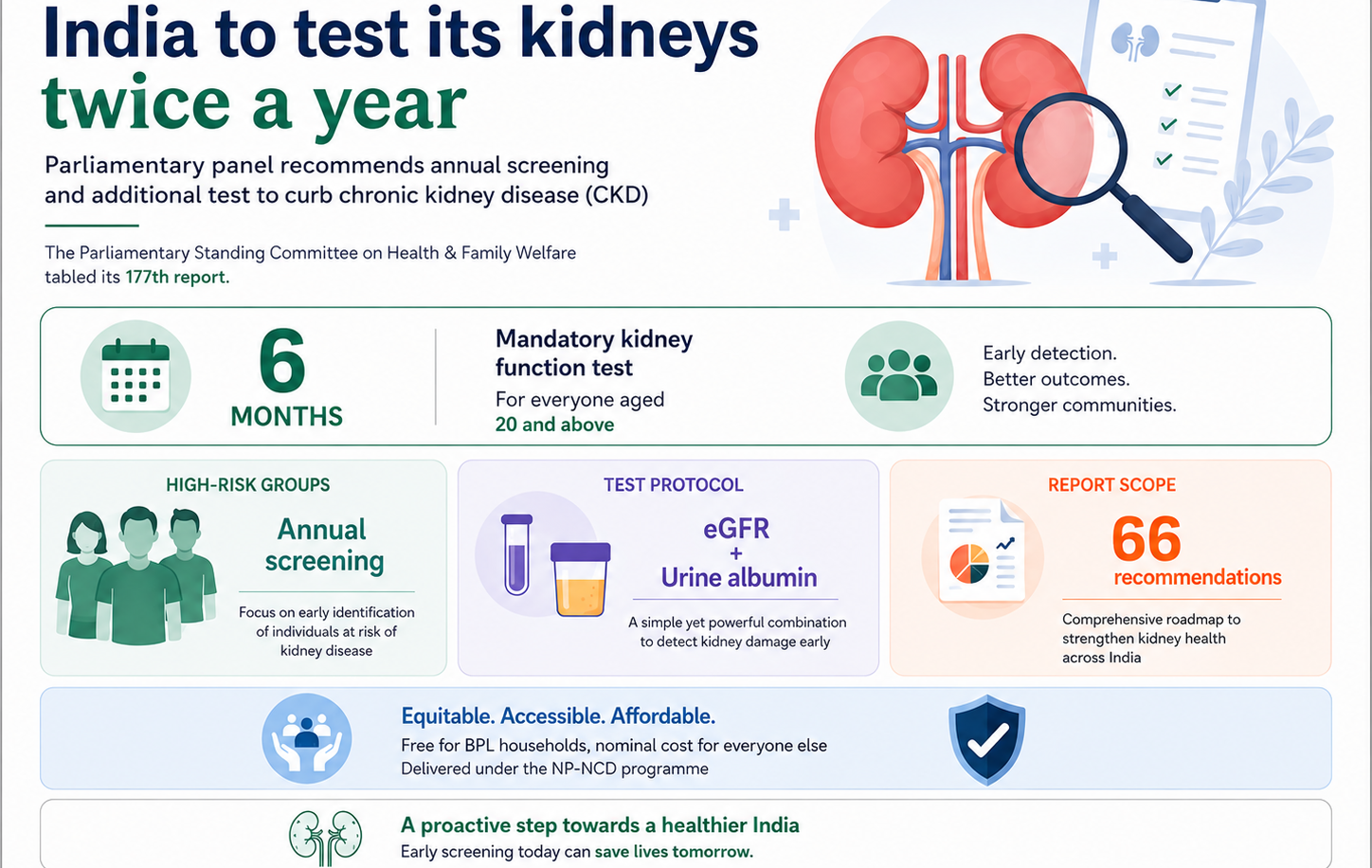
On 7th August 2026, the Department-related Parliamentary Standing Committee on Health and Family Welfare tabled its 177th report before both Houses of Parliament, titled "Prevalence of Chronic Kidney Disease in India, Prevention, Diagnosis, Treatment and Management." Headed by Rajya Sabha member Professor Ram Gopal Yadav, the report lays out 66 recommendations aimed at reshaping how India approaches one of its fastest-growing non-communicable diseases. At its core is a single, consequential proposal: mandatory kidney function testing every six months for every adult in the country aged 20 and above, alongside annual screening for those already known to be at higher risk.
This is not a minor procedural update. It represents a genuine shift in philosophy, away from a healthcare system built to treat kidney failure once it arrives, and toward one designed to catch kidney disease years before symptoms ever appear.
Why the Committee Felt This Was Necessary
The report is direct about the scale of the problem. The committee cited a pooled national CKD prevalence of approximately 13.24 percent, meaning roughly one in eight adults in India may already be living with some degree of chronic kidney disease. What makes this figure especially concerning is the disease's behaviour in its early stages. Chronic kidney disease frequently produces no noticeable symptoms until a substantial, and often irreversible, proportion of kidney function has already been lost. By the time patients present with fatigue, swelling, or other visible signs, the window for meaningful intervention has, in many cases, already narrowed considerably.
The committee also flagged that preventive nephrology, the branch of medicine focused on catching kidney disease before it progresses, has historically received far less policy and financial attention in India than the scale of the problem warrants. Its central recommendation directly addresses this gap.
What the Committee Has Recommended
The report calls for the biannual kidney function test to be made available free of cost for people below the poverty line, and at a nominal cost for those above it, delivered through the existing National Programme for Prevention and Control of Non-Communicable Diseases. For individuals already identified as high-risk, including people with diabetes or hypertension, adults over 60, those with a family history of kidney disease, people who use tobacco or carry excess weight, individuals with a prior history of kidney injury, recurrent urinary infections, or kidney stones, and those on long-term NSAID use, the committee recommends annual testing at minimum.
Crucially, the committee was specific about what this screening should actually measure. It recommended that testing for high-risk individuals include assessment of kidney function using estimated glomerular filtration rate, or eGFR, together with urine albumin or protein testing, followed by appropriate referral and follow-up. This detail matters enormously. It signals that the committee is not simply asking for more testing, but for the right combination of tests, one that looks at both how well the kidneys are currently filtering blood and whether there is early evidence of damage to the kidney's filtering units, a sign that frequently shows up before eGFR itself begins to decline.
Beyond the screening mandate itself, the report's other recommendations point to a broader institutional buildout. It calls for a dedicated National CKD Programme modelled on India's successful HIV and AIDS response, the establishment of a National CKD Registry for systematic surveillance, a district-wise CKD Performance Dashboard to track screening coverage and outcomes, and targeted screening programmes for agricultural and occupational communities in regions affected by chronic kidney disease of unknown etiology, specifically naming Andhra Pradesh, Odisha, and Karnataka, where heat stress, recurrent dehydration, and agrochemical exposure are believed to contribute to kidney damage. The committee additionally recommended strengthening nephrology services at the district level, expanding dialysis and transplantation capacity, promoting home-based peritoneal dialysis, encouraging the adoption of digital health technologies, and introducing basic kidney health education into school curricula.
Why This Recommendation Matters So Much Right Now
Recommendations of this scale are only as meaningful as the infrastructure built to carry them out, and this is precisely where the real challenge begins. Mandating biannual kidney testing for every adult above 20 means designing a screening system capable of reaching several hundred million people, twice a year, largely through primary and community health centres rather than specialist hospitals. India's existing screening apparatus under the NP-NCD, delivered through Ayushman Arogya Mandirs, already covers non-communicable disease screening for adults above 30, but extending both the age threshold and the testing frequency at this scale demands diagnostic tools that are fast, affordable, and usable without dependence on centralised laboratory infrastructure.
This is also where the committee's specific choice of tests becomes so significant. Recommending eGFR and urine albumin testing together, rather than either test in isolation, reflects a growing recognition within nephrology that these two markers catch different things at different points in the disease's progression. Relying on eGFR alone risks missing early kidney damage that has not yet affected overall filtration capacity, while relying on urine testing alone provides an incomplete picture of overall kidney function. Together, they offer a far more complete early-warning system, but only if both tests can actually be delivered at the point of care, at the volume this recommendation demands.
The Indian Society of Nephrology Adds Its Voice
The parliamentary committee's recommendation did not arrive in isolation. On the occasion of World Kidney Day 2026, whose theme this year was "Kidney Health for All: Caring for People, Protecting the Planet," the Indian Society of Nephrology, the country's principal professional body for kidney specialists with a membership of over 3,300 nephrologists, raised much the same alarm the parliamentary committee had, from the clinical frontline rather than the policy floor. A high-level ISN delegation, led by Dr Shyam Bihari Bansal, Senior Director and Head of the Department of Nephrology and Kidney Transplant Medicine and ISN Secretary, met Union Health Minister JP Nadda and handed over a memorandum urging the ministry to formally include chronic kidney disease as a core component of the National Programme for Prevention and Control of Non-Communicable Diseases, the same government framework that already covers diabetes and hypertension.
The scale the ISN cited was stark. India's CKD prevalence, the memorandum noted, has surged past 16 percent, with projections suggesting the disease could become one of the top five causes of death in the country by 2040. Dr Bansal pointed out that a significant share of this burden goes undiagnosed until it reaches an advanced stage, straining both patients and the healthcare system and often pushing families into catastrophic out-of-pocket expenditure, a burden he noted is made more frustrating by how much of India's CKD stems from risk factors that are preventable or modifiable. The memorandum linked the disease's rising trajectory to a wider set of contributors than diabetes and hypertension alone, also naming cardiovascular disease, maternal health complications, recurrent acute kidney injury, and environmental exposures, and it framed its central request as a deliberate shift in national strategy, away from dialysis-centric care and toward prevention-focused kidney health.
Within that broader ask sat the same specific, practical recommendation the parliamentary committee had also converged on. The memorandum was signed by Dr Ashwini Gupta, President of the Indian Society of Nephrology, Dr Vijay Kher, Chairman of the Society's Advocacy Group and a past ISN president, and Dr Sandeep Mahajan, member of the Advocacy Group and Chair of the South Asia Region for the International Society of Nephrology. Their argument was direct and specific: routinely testing people who already fall into recognised high-risk categories, those with diabetes, hypertension, cardiovascular disease, a family history of kidney disease, or an age above 60, using simple and inexpensive tests centred on urine albumin and creatinine, could meaningfully cut down the number of patients who are only diagnosed once their disease has already progressed to an advanced, much harder to treat stage. A structured screening and referral programme built around this testing, the ISN argued, would not only reduce progression to kidney failure and ease the growing dialysis burden, but also meaningfully lower the cardiovascular illness and mortality so closely tied to declining kidney function.
Just as significantly, the nephrologists did not call for new infrastructure to be built from scratch to make this happen. They urged that India's existing Primary Health Centre network, along with the more recently established Ayushman Arogya Mandirs, be used to carry out this testing on a regular basis, alongside large-scale public awareness efforts and ISN's own offer to support the ministry with guidelines, training modules, and technical expertise. This aligns with the parliamentary committee's own recommendations, which similarly called for screening to be delivered through existing primary and community health infrastructure rather than requiring patients to seek out specialist facilities that, in much of the country, are simply out of reach.
This degree of alignment is unusual. Parliamentary committees and professional medical societies do not always arrive at the same policy conclusions, and each typically works from a different vantage point, one shaped by public testimony and cross-sectoral policy review, the other by decades of direct clinical experience treating the patients this disease actually affects. When both independently converge on the same basic prescription, routine, low-cost testing of high-risk groups, delivered through the primary care network that already exists, it signals something closer to consensus than coincidence, and for a disease that has historically received comparatively little sustained policy attention relative to its burden, that alignment is itself a meaningful development.
Why Urine Albumin-to-Creatinine Testing Sits at the Centre of Both Recommendations
Read side by side, the parliamentary committee's report and the Indian Society of Nephrology's memorandum are, in effect, converging on the same clinical priority from two different directions. The committee called for eGFR and urine albumin testing together. The country's leading body of nephrologists called for regular testing built around urine albumin and creatinine in exactly the population most likely to benefit from catching kidney damage early. Both are pointing, with slightly different phrasing, at the same underlying diagnostic principle: albuminuria screening, most precisely captured through the urine albumin-to-creatinine ratio, or uACR, deserves to sit at the centre of how India screens for kidney disease at scale.
uACR is a relatively simple concept with an outsized clinical payoff. It measures the amount of albumin, a protein that should barely be present in urine under normal circumstances, relative to the amount of creatinine in that same sample. When the kidney's filtering units begin to sustain damage, even damage subtle enough that eGFR has not yet declined, albumin starts leaking into urine in small but detectable amounts, making uACR one of the earliest reliable warning signs in kidney medicine, often identifiable years before eGFR shows any meaningful drop. It is also one of the easiest tests to deliver at scale: unlike an injected clearance marker or a full metabolic panel, uACR only requires a single spot urine sample, with no fasting, no injections, and no separate blood draw.
This combination of early clinical signal and practical simplicity is why both bodies arrived at broadly the same conclusion independently. A screening effort large enough to reach every adult above 20 twice a year, or every high-risk patient identified through primary care, cannot realistically be built around tests that require specialist equipment or centralised laboratory processing at every site. It has to be built around a test a primary health centre or an Ayushman Arogya Mandir, often staffed without resident specialists, can deliver reliably and at volume. uACR is, by a wide margin, the test best positioned to meet that requirement.
Where Proflo-U Fits Into This Moment
This is the exact gap that Prantae Solutions has been building toward. Proflo-U, our patented, CDSCO-approved point-of-care platform, already brings lab-grade urine albumin-to-creatinine ratio testing directly to primary and community health settings, without requiring samples to be sent to a distant laboratory or patients to wait days for results. We are now working to expand this capability further, upgrading Proflo-U to also deliver automated eGFR measurement from serum creatinine on the same platform. Once complete, this upgrade will allow a single point-of-care device to deliver both tests the parliamentary committee has explicitly recommended, uACR and eGFR, from one patient visit, at the primary care level, without the delays and infrastructure demands that centralised lab-based testing would impose at national scale.
For a screening mandate this ambitious to succeed, the tools used to deliver it need to match its scale. A national programme asking every adult over 20 to be tested twice a year cannot realistically depend on infrastructure built for occasional, symptom-triggered testing. It needs diagnostic platforms designed from the outset for high-volume, decentralised, primary-care deployment, precisely the direction Proflo-U's upcoming eGFR integration is built to support. As India's Ayushman Arogya Mandirs and district health systems begin preparing to operationalise these recommendations, a combined uACR and eGFR platform at the point of care could meaningfully close the gap between what this report asks for and what frontline health infrastructure is currently equipped to deliver.
Reaching the Exact Ground the ISN Named
The Indian Society of Nephrology was specific about where it wants this testing carried out: the Primary Health Centre network and the Ayushman Arogya Mandirs, the very settings where a resident nephrologist is rarely, if ever, present. This is precisely the ground Proflo-U's quantitative uACR testing is built to reach. Because the test requires only a single urine sample and delivers a lab-grade, quantitative result at the point of care, it does not depend on a specialist to be administered correctly, nor does it require samples to be batched and sent elsewhere for processing. A frontline health worker at a PHC or Ayushman Arogya Mandir can run the test as part of a routine visit for a patient with diabetes, hypertension, or any of the other risk factors the ISN named, and get an accurate, actionable result before that patient leaves the building.
For the ISN's recommendation to translate into fewer late-stage diagnoses on the ground, it will depend on this kind of integration: testing that fits into the visit a high-risk patient is already making, rather than asking them to seek out a separate, harder-to-reach facility simply to be screened. A diabetic patient at a routine check-up, or an older adult visiting an Ayushman Arogya Mandir for an unrelated concern, could have their kidney risk assessed in the same sitting, without an additional appointment, journey, or cost that many patients most at risk of CKD in India can least afford. Multiplied at the scale both the parliamentary committee and the ISN are asking for, this kind of frictionless, opportunistic screening may be the difference between a well-intentioned recommendation and one that genuinely changes how early India catches this disease.
From Recommendation to Reality
A parliamentary report, however well-researched, is only ever the starting point. Its 66 recommendations now sit with the Ministry of Health and Family Welfare, awaiting the harder work of implementation, budgeting, and rollout across a health system as vast and varied as India's. But the direction this report sets is unambiguous: the country's approach to kidney disease is meant to shift from reacting to failure toward preventing it in the first place. Whether that shift actually reaches the primary health centre in a small town or the community screening camp in a farming district will depend less on how the recommendation was written, and more on whether the diagnostic tools needed to deliver it are ready and waiting when the call finally comes.
Sources: 177th Report of the Department-related Parliamentary Standing Committee on Health and Family Welfare, "Prevalence of Chronic Kidney Disease in India – Prevention, Diagnosis, Treatment and Management," presented to Parliament on 7th August 2026. Indian Society of Nephrology memorandum on national CKD screening, as reported by The New Indian Express, March 2026.